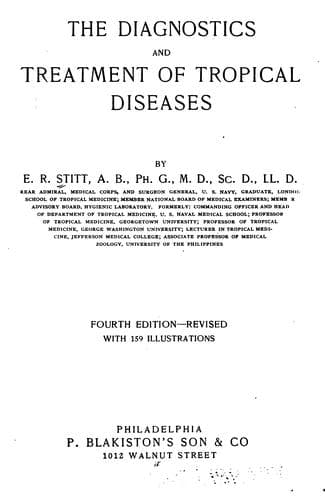
The diagnostics and treatment of tropical diseasesStitt, E. R. (Edward Rhodes)
Science
The diagnostics and treatment of tropical diseases
Stitt, E. R. (Edward Rhodes)
Tropical medicine
It was originally my idea to prepare a book which would enable
students to have presented to them in intimate relation the
laboratory and clinical aids to the diagnosis of tropical diseases. I
was forced to abandon this plan as it did not seem possible to take
up clinical diagnosis prior to the obtaining by the student of a
comprehensive knowledge of the facts in connection with each separate
tropical disease. There was not the same difficulty attaching to a
book exclusively devoted to the diagnostic methods of the laboratory
so that in 1908 a laboratory manual was published. More recently it
has occurred to me that my methods in teaching tropical medicine
from the clinical rather than the laboratory standpoint might be of
assistance to those who are interested in this very important branch
of medicine.
When we consider that a knowledge of malaria, blackwater fever,
amoebic dysentery, bacillary dysentery, liver abscess, pellagra and
hookworm disease is just as important for the medical man in the
Southern States of the United States as for the physician in tropical
colonial possessions, it will be realized that there is more of a
practical side to tropical medicine than is usually admitted.
Although this is intended as a companion volume to the one on
laboratory methods yet, in order to make it complete in itself, there
has been prepared under each disease a paragraph dealing with the
laboratory diagnosis of the disease under consideration.
Furthermore, under the sections on the blood, faeces and urine in the
diagnosis of tropical diseases, the laboratory methods which are of
practical application have been given.
The chief feature of the book is in presenting in Part II the
clinical side of tropical diseases from a standpoint of the signs
and symptoms of these diseases which are connected with anatomical
or clinical groupings rather than from the side of the individual
disease. Thus in Chapter XLIV the diagnostic points which may be
obtained from a study of the temperature chart are given while in
Chapter LII the neurological manifestations, which may be noted in
various tropical diseases, are presented.
In Part I each individual tropical disease is treated as taken up
in any of the well-known books on tropical medicine. It has seemed
to me, however, that the paragraphs on epidemiology and prophylaxis
should receive especial attention. Again, in order to bring out
more strongly the symptomatology of each disease, I have followed
the paragraph on symptomatology in general with a section dealing
with the symptoms in detail, as shown in a consideration of the
circulatory, respiratory, digestive, nervous and other systems.
The paragraph devoted to the definition of each important disease has
been prepared with a view to giving the reader a brief description of
the disease in its clinical and etiological aspects.
Public-domain text, read in full here on John Shaqi.
Reviews
Reviews
No reviews yet
Be the first to share your thoughts on this work.
Join the Discussion
Join the discussion
Sign in to leave a comment or review.
Sign InorCreate an account