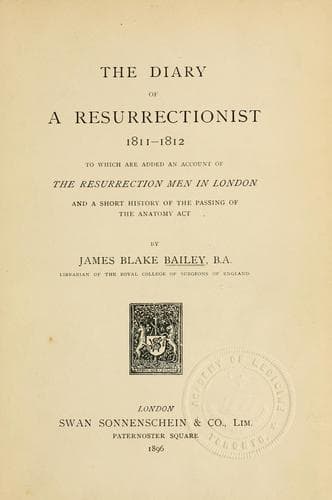
The Diary of a Resurrectionist, 1811-1812: To Which Are Added an Account of the Resurrection Men in London and a Short History of the Passing of the Anatomy ActBailey, James Blake
History
The Diary of a Resurrectionist, 1811-1812: To Which Are Added an Account of the Resurrection Men in London and a Short History of the Passing of the Anatomy Act
Bailey, James Blake
Body snatching
It would have been quite impossible for the resurrection-men to have
obtained the number of bodies they frequently did, had they not been able
to bribe the custodians of the different burial-grounds. Sometimes they
met with a difficulty in the shape of a keeper newly appointed to replace
one who had been dismissed for being privy to these depredations. In most
instances this was soon overcome; if, at the outset, the custodian could
not be bribed, he could generally be induced to drink, and then, whilst he
was in a state of intoxication, the body which the resurrection-men wished
to obtain could be easily removed. After this first step there was
generally very little difficulty in the future.
Sometimes, too, the grave-diggers not only gave information to the
Resurrectionists, but acted as principals themselves. In Benson's
_Remarkable Trials_ is recorded the case of John Holmes, Peter Williams,
and Esther Donaldson. Holmes was grave-digger at St. George's, Bloomsbury;
Williams was his assistant, and Donaldson was charged as an accomplice.
They were prosecuted before Sir John Hawkins at the Guildhall,
Westminster, in December, 1777, for stealing the body of Mrs. Jane
Sainsbury, who died in the previous October, and was buried in the St.
George's burial-ground. Holmes and Williams were sentenced to six months'
imprisonment, and to be whipped on their bare backs from the end of
Kingsgate Street, Holborn, to Dyot Street, St. Giles. The sentence, says
Benson, was duly carried out amidst crowds of well-satisfied and approving
spectators. The woman Donaldson was acquitted.
The ranks of the resurrection-men were largely recruited from the keepers
of burial-grounds. When these men had lost their situations for
connivance at the stealing of bodies, they naturally joined their old
associates, and became part of the regular gang.
The bribery of the custodians will account for the large number of bodies
often obtained in one night. Had there been the slightest vigilance on the
part of the authorities, it would have been absolutely impossible for the
resurrection-men to have spent the time necessary for their work without
detection. The amount of time required for the work depended greatly on
the soil. One man told Bransby Cooper that he had taken two bodies from
separate graves of considerable depth, and had restored the coffins and
the earth to their former positions in an hour and a half. Another man
said that he had completed the exhumation of a body in a quarter of an
hour; but in this instance the grave was extremely shallow, and the earth
loose and without stones. If much gravel had to be dug through, the
resurrection-men had a peculiar way of using their spades, so that the
gravel was thrown out of the grave quite noiselessly.
Public-domain text, read in full here on John Shaqi.
Reviews
Reviews
No reviews yet
Be the first to share your thoughts on this work.
Join the Discussion
Join the discussion
Sign in to leave a comment or review.
Sign InorCreate an account