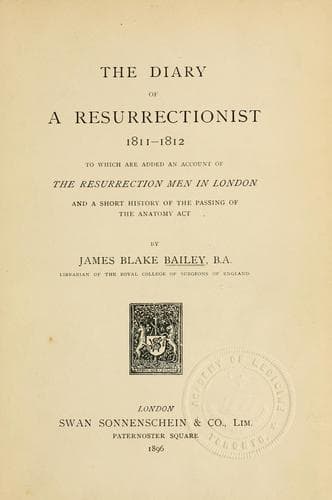
The Diary of a Resurrectionist, 1811-1812: To Which Are Added an Account of the Resurrection Men in London and a Short History of the Passing of the Anatomy Act — John Shaqi
The Diary of a Resurrectionist, 1811-1812: To Which Are Added an Account of the Resurrection Men in London and a Short History of the Passing of the Anatomy ActBailey, James Blake
History
The Diary of a Resurrectionist, 1811-1812: To Which Are Added an Account of the Resurrection Men in London and a Short History of the Passing of the Anatomy Act
Bailey, James Blake
Body snatching
On Thursday, February 20th, 1812, the Diary tells us that 15 large bodies
and one small one were obtained from St. Pancras. No doubt this was
simplified by the custom of burying several paupers in one grave. To
obtain these it was necessary to dig all the earth out, so that each
coffin could be dealt with; the men generally worked very soon after a
funeral, and so the earth was much more easily moved than it would have
been if they had been obliged to dig through undisturbed ground. When only
one body was to be had, a small opening was dug down to the head of the
coffin, which was then broken open, and the body was pulled up with a
rope, fastened either round the neck or under the armpits.
In a memoir of Thomas Wakley, the founder of _The Lancet_,[13] the
following account of the _modus operandi_ of the resurrection-men is
given: "In the case of a neat, or not quite new grave, the ingenuity of
the Resurrectionist came into play. Several feet--fifteen or twenty--away
from the head or foot of the grave, he would remove a square of turf,
about eighteen or twenty inches in diameter. This he would carefully put
by, and then commence to mine. Most pauper graves were of the same depth,
and, if the sepulchre was that of a person of importance, the depth of the
grave could be pretty well estimated by the nature of the soil thrown up.
Taking a five-foot grave, the coffin lid would be about four feet from the
surface. A rough slanting tunnel, some five yards long, would, therefore,
have to be constructed, so as to impinge exactly on the coffin head. This
being at last struck (no very simple task), the coffin was lugged up by
hooks to the surface, or, preferably, the end of the coffin was wrenched
off with hooks while still in the shelter of the tunnel, and the scalp or
feet of the corpse secured through the open end, and the body pulled out,
leaving the coffin almost intact and unmoved.
"The body once obtained, the narrow shaft was easily filled up and the sod
of turf accurately replaced. The friends of the deceased, seeing that the
earth _over_ his grave was not disturbed, would flatter themselves that
the body had escaped the Resurrectionist; but they seldom noticed the
neatly-placed square of turf, some feet away."
Public-domain text, read in full here on John Shaqi.
Reviews
Reviews
No reviews yet
Be the first to share your thoughts on this work.
Join the Discussion
Join the discussion
Sign in to leave a comment or review.
Sign InorCreate an account