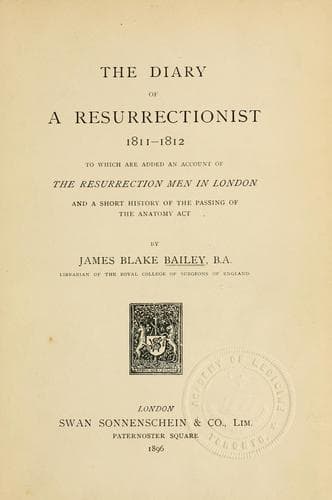
The Diary of a Resurrectionist, 1811-1812: To Which Are Added an Account of the Resurrection Men in London and a Short History of the Passing of the Anatomy ActBailey, James Blake
History
The Diary of a Resurrectionist, 1811-1812: To Which Are Added an Account of the Resurrection Men in London and a Short History of the Passing of the Anatomy Act
Bailey, James Blake
Body snatching
The difficulty of getting reliable information is increased by the
incomplete nature of most of the newspaper records. In many cases there is
an account of a preliminary examination of some of the men who were
arrested for body-stealing. The report states that they were remanded, but
further search fails to find any subsequent notice of the case. It is
often impossible to fix who the men were who thus got into trouble, as
they nearly always gave false names: unless they were too well-known to
the police who arrested them, they invariably did this.
For the photographs, from which the illustrations of the house at Crail
are taken, the writer is indebted to the kindness of Prof. Chiene, of
Edinburgh.
THE DIARY OF A RESURRECTIONIST
CHAPTER I.
The complaint as to the scarcity of bodies for dissection is as old as the
history of anatomy itself. Great respect for the body of the dead has
characterised mankind in nearly all ages; _post mortem_ dissection was
looked upon as a great indignity by the relatives of the deceased, and
every precaution was taken to prevent its occurrence.
It would be beyond the scope of the present work to attempt a history of
anatomical teaching; as will be pointed out later on, the resurrection-men
did not come into existence until the early part of the eighteenth
century.
In Great Britain the study of medicine and surgery was much hampered at
this date by the scarcity of opportunities by which the student might get
a practical acquaintance with the anatomy of the human body. A knowledge
of anatomy was insisted upon by the Corporation of Surgeons, as each
student had to produce a certificate of having attended at least two
courses of dissection. It is unnecessary to point out the wisdom of this
condition in the case of men who were to go out into the world as
surgeons, and, consequently, to have the lives of their fellow-men in
their hands. The attendance on the two courses of dissection could be
evaded, and this was frequently done. The Apothecaries' Hall had no such
restriction, and, consequently, many men went thither and received a
qualification to practise, although they were quite unacquainted with
human anatomy. The work of such 'prentice hands one trembles to think of;
whatever experience these men did gain was obtained after they began to
practise, and so must have been at the expense of their patients, who were
generally those of the poorer class in life.
Public-domain text, read in full here on John Shaqi.
Reviews
Reviews
No reviews yet
Be the first to share your thoughts on this work.
Join the Discussion
Join the discussion
Sign in to leave a comment or review.
Sign InorCreate an account