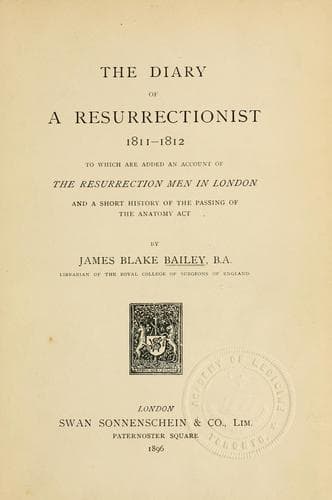
The Diary of a Resurrectionist, 1811-1812: To Which Are Added an Account of the Resurrection Men in London and a Short History of the Passing of the Anatomy Act — John Shaqi
The Diary of a Resurrectionist, 1811-1812: To Which Are Added an Account of the Resurrection Men in London and a Short History of the Passing of the Anatomy ActBailey, James Blake
History
The Diary of a Resurrectionist, 1811-1812: To Which Are Added an Account of the Resurrection Men in London and a Short History of the Passing of the Anatomy Act
Bailey, James Blake
Body snatching
It was pointed out by Mr. Guthrie, that in the then state of the law a
surgeon might be punished in one Court for want of skill, and in another
Court the same individual might also be punished for trying to obtain that
skill. Before the Anatomy Committee, in 1828, Sir Astley Cooper narrated
the case of a young man who was rejected at the College of Surgeons on
account of his ignorance of the parts of the body; it was found, on
enquiry, that he was a most diligent student, and that his ignorance arose
entirely from his being unable to procure that which was necessary for
carrying on this part of his education.
When bodies were obtained for dissection it was generally by surreptitious
means; the newly-made grave was too often the source from whence the
supply was obtained. At first there was no direct trade or traffic in
subjects by men who devoted all their efforts to this mode of obtaining a
livelihood. The students supplied their own wants as they arose. Mr. G. S.
Patterson told the Committee that at St. George's Hospital the students
had to exhume bodies for their own use.
In the _Diary of a Late Physician_ Samuel Warren has given us a chapter on
this subject, which he calls "Grave Doings," and which is probably
founded on fact. The object in the expedition here recorded was, however,
rather to obtain a valuable pathological specimen, than to get a body for
dissection. Writers of fiction have made use of body-snatching, and have
given a gruesome turn to their stories by making the body, when uncovered,
turn out to be that of a relation or friend of some one of the party
engaged in the exhumation. Such a tale is recorded in the _Monthly
Magazine_ for April, 1827; there a sailor is pressed into the service of
some students who were anxious to obtain a body. The subject was safely
brought home, and, on being taken from the sack, turned out to be the
sweetheart of the sailor, who had just returned from sea, and, not having
heard of his girl's decease, was on his way to greet her after a long
absence from home. Truth and fiction often agree. There is a case on
record of a child who had died of scrofula, and whose body was brought to
St. Thomas' Hospital by Holliss, a well-known resurrectionist. The body
was at once recognised by one of the students as that of his sister's
child; on this being made known to the authorities at the hospital, the
corpse was immediately buried before any dissection had taken place.
Public-domain text, read in full here on John Shaqi.
Reviews
Reviews
No reviews yet
Be the first to share your thoughts on this work.
Join the Discussion
Join the discussion
Sign in to leave a comment or review.
Sign InorCreate an account