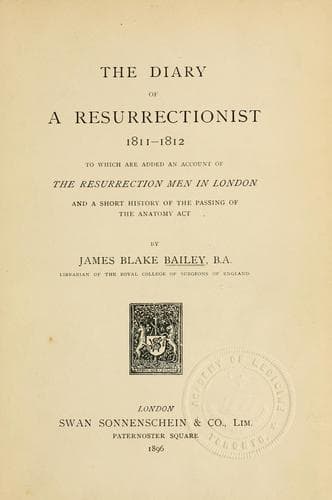
The Diary of a Resurrectionist, 1811-1812: To Which Are Added an Account of the Resurrection Men in London and a Short History of the Passing of the Anatomy ActBailey, James Blake
History
The Diary of a Resurrectionist, 1811-1812: To Which Are Added an Account of the Resurrection Men in London and a Short History of the Passing of the Anatomy Act
Bailey, James Blake
Body snatching
By the Act Henry VIII., xxii., cap. 12, provision was made for the Company
of Barbers and Surgeons to have the bodies of malefactors for the purpose
of dissection. This part of the Act was as follows: "And further be it
enacted by thauctoritie aforesayd, that the sayd maysters or governours of
the mistery and comminaltie of barbours and surgeons of Londo & their
successours yerely for ever after their sad discrecions at their free
liberte and pleasure shal and maie have and take without cõtradiction
foure persons condempned adjudged and put to deathe for feloni by the due
order of the Kynges lawe of thys realme for anatomies with out any further
sute or labour to be made to the kynges highnes his heyres or successors
for the same. And to make incision of the same deade bodies or otherwyse
to order the same after their said discrecions at their pleasure for their
further and better knowlage instruction in sight learnyng & experience in
the sayd scyence or facultie of Surgery."
The "foure bodies" could not always be obtained without difficulty;
despite the precautions of the Company private anatomy was, to a certain
extent, carried on, and the bodies of malefactors had a market value. The
following entries from the _Annals of the Barber Surgeons_ are
illustrative of this:
"6th March, 1711.[5] It is ordered that William Cave, one of the Beadles
of this Company, do make Inquiry who the persons were that carryed away
the last body from Tyburne, and that such persons be Indicted for the
same.
"9th October, 1711. Richard Russell, one of the persons who stands
Indicted for carrying away the last publick body applying himself to this
Court and offering to be evidence against the rest of the persons
concerned It is ordered that the Clerk do apply himself to Her Majesty's
Attorney Generall for a Noli p'sequi as to the said Russell in order to
make him an evidence upon the s{d} Indictment and particularly ag{st} one
Samuell Waters whom the Court did likewise order to be indicted for the
said fact."
Often there were riots caused by the Beadles of the Company going to
Tyburn for the bodies of murderers. This rioting was carried to such an
extent that it was found necessary to apply for soldiers to protect the
Beadles.
"28th May, 1713. Ordered that the Clerk go to the Secretary at War for a
guard in order to gett the next Body [from Tyburn.]"
The dissection of these bodies was made known by public advertisement. The
following is from the _Daily Advertiser_ of January 15th, 1742: "Notice is
hereby given that there being a publick Body at Barbers and Surgeons Hall,
the Demonstrations of Anatomy and the Operations of Surgery will be at the
Hall this evening and to-morrow at six o'clock precisely in the
Amphitheatre."
In 1752 it was ordered that bodies of murderers executed in London and
Middlesex should be conveyed to the Hall of the Surgeons Company to be
dissected and anatomized, and any attempt to rescue such bodies was made
felony.
Public-domain text, read in full here on John Shaqi.
Reviews
Reviews
No reviews yet
Be the first to share your thoughts on this work.
Join the Discussion
Join the discussion
Sign in to leave a comment or review.
Sign InorCreate an account