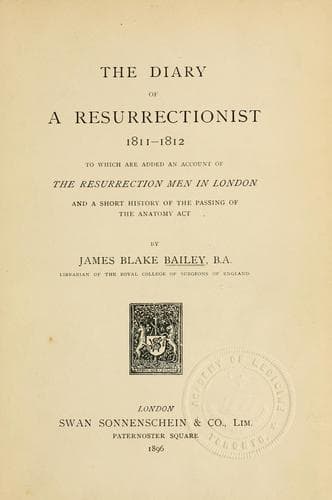
The Diary of a Resurrectionist, 1811-1812: To Which Are Added an Account of the Resurrection Men in London and a Short History of the Passing of the Anatomy ActBailey, James Blake
History
The Diary of a Resurrectionist, 1811-1812: To Which Are Added an Account of the Resurrection Men in London and a Short History of the Passing of the Anatomy Act
Bailey, James Blake
Body snatching
In vols. 1 and 2 of the _Medical Times_ there is a series of articles,
entitled "The Confessions of Jasper Muddle, Dissecting-room Porter." These
papers are signed "Rocket," but were written by Albert Smith.[2] One of
the articles contains an account of a handsome young lady who came to the
dissecting-room late at night, and begged for the body of a murderer
executed the previous day, which was then being injected, ready for
lecture purposes. In the _Tale of Two Cities_, Dickens has given us a good
study of a resurrection-man in the person of Mr. Cruncher. Moir in _Mansie
Wauch_, Lytton in _Lucretia_, Mrs. Crowe in _Light and Darkness_, and Miss
Sergeant in _Dr. Endicott's Experiment_, have also used the body-snatcher
in fiction.
As long as the Barber Surgeons kept to their right of the exclusive
teaching of anatomy, there was small need of bodies for dissection. This
right the Company jealously guarded. On 21st May, 1573, the following
entry occurs in the records, "Here was John Deane and appoynted to brynge
in his fyne x{li} for havinge an Anathomye in his howse contrary to an
order in that behalf between this and mydsomer next."[3] As late as 1714
this rule was put in force against no less a man than William Cheselden.
The entry in the books of the Company runs as follows, "At a Court of
Assistants of the Company of Barbers and Surgeons, held on the 25th March,
1714. Our Master acquainting the Court that Mr. William Cheselden, a
member of this Company, did frequently procure the Dead bodies of
Malefactors from the place of execution and dissect the same at his own
house, as well during the Company's Publick Lectures as at other times
without the leave of the Governors and contrary to the Company's By law in
that behalf. By which means it became more difficult for the Beadles to
bring away the Companies Bodies and likewise drew away the members of this
Company and others from the Public Dissections and Lectures at the Hall.
The said Mr. Cheselden was, therefore, called in. But having submitted
himself to the pleasure of the Court with a promise never to dissect at
the same as the Company had their Lecture at the Hall, nor without leave
of the Governors for the time being, the said Mr. Cheselden was excused
for what had passed with a reproof for the same pronounced by the Master
at the desire of the Court."[4]
Public-domain text, read in full here on John Shaqi.
Reviews
Reviews
No reviews yet
Be the first to share your thoughts on this work.
Join the Discussion
Join the discussion
Sign in to leave a comment or review.
Sign InorCreate an account