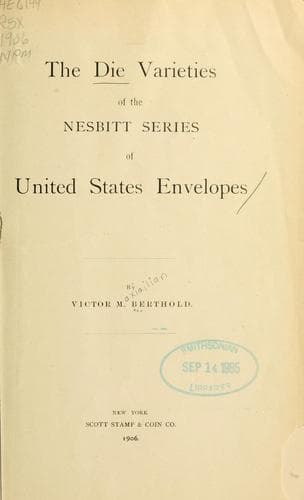
The Die Varieties of the Nesbitt Series of United States EnvelopesBerthold, Victor Maximilian
History
The Die Varieties of the Nesbitt Series of United States Envelopes
Berthold, Victor Maximilian
Postage stamps -- United States
As in former issues, the engraver has presented the collector with
various heads which differ in the arrangement of the hair but, as in
addition to these minor details the lettering of the various dies is a
far more essential feature, it has not been thought necessary to
reproduce the heads.
To find the main varieties the following system, based on line
prolongation, has been adopted:
Draw a straight line along the outer vertical stroke of the final "E"
of "THREE" and note its position with regard to letters "D," "S" and
"T" of " UNITED STATES." This establishes four main groups or classes.
Class I.--The line runs to the left of "S" of STATES.
Class II.--The line passes through "S."
Class III.--The line touches the upper bar of "T" to left.
Class IV.--The line runs through centre of "T" or beyond it.
[Illustration: I, II, III, IV]
The varieties of this die are, furthermore, plainly differentiated by
the size of the letters used for the inscription. There are three
sizes:--very tall letters, medium size, and decidedly small letters.
Even a cursory observation reveals various shapes of the letter "C" of
"CENTS," and "D" of "UNITED." Likewise, the spacing between the words
and the distance from the words to the circles containing the numerals
of value vary considerably.
Formerly the existence of a broken circle at the side was chronicled as
one of the most noteworthy varieties, but this feature is of little
value. The philatelist may, however, be interested to hear the opinion
of Messrs. Tiffany, Bogert and Rechert: "We have concluded that only
two varieties are worthy of a place in our list. The others, though
existing, are too minute to interest the average collector."
The above statement only proves that Horace is right when he assures us
"_Quandoque bonus dormitat Homerus_." Now and then the best experts are
asleep! In the writer's opinion all the varieties of the three cents
rose cannot fail to interest the collector, and no two can be singled
out as being of more or less importance.
By using a 10 mm. unit distance measurement, we detect numerous other
varieties, of which some are shown in the subjoined diagram.
[Illustration]
We are now prepared to study the several varieties of Dies A and B.
DIE A.
CLASS II.
[Illustration]
Variety 1:--Elongated "C" without dot in centre. The
lettering is large. Wide, open "U." "NITE" widely spaced,
especially "TE." "ED" near. "U" far from "3." "DS" near. "S"
of "STATES" near "3." "T" of "THREE" far from "3." "HR"
wide. "RE" wide at top. "NT" wide at base. "S" large and far
from "3." Uncommon on white, very rare on buff.
Public-domain text, read in full here on John Shaqi.
Reviews
Reviews
No reviews yet
Be the first to share your thoughts on this work.
Join the Discussion
Join the discussion
Sign in to leave a comment or review.
Sign InorCreate an account