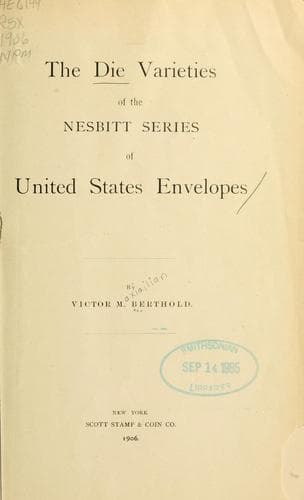
The Die Varieties of the Nesbitt Series of United States EnvelopesBerthold, Victor Maximilian
History
The Die Varieties of the Nesbitt Series of United States Envelopes
Berthold, Victor Maximilian
Postage stamps -- United States
So far I have not spoken of the various forms of watermarks employed by
Nesbitt, nor of the tresses, or seals, found on the flaps. These are of
importance to the collector of entire envelopes, but are a negligible
quantity for those who prefer to get the die varieties as cut square
specimens.
As it is evident that the purpose of the present work is to enable the
great body of collectors of United States stamps to become well
acquainted with the early Nesbitt varieties, hitherto considered the
exclusive property of the specialist, I suggest to the powers that
supply our need in the way of stamp albums to prepare a couple of extra
pages, showing the die and its main varieties. A friend of the writer,
an enthusiastic collector of cut square specimens, has adopted this
plan and it is certain that if any of our readers had an opportunity to
see how attractive and interesting these pages appear, they would not
hesitate to do likewise.
Perhaps this suggestion will be heeded by the album publishers. If so,
there will soon spring up special groups of collectors of the early
Nesbitt Die Varieties.
In conclusion I desire to express to Messrs. J. M. Bartels, Edward H.
Mason and Geo. Rauh, all of Boston, my sincere thanks for the valuable
aid which they have rendered me in preparing this work.
Mr. Bartels has worked with me continuously in my investigations into
the intricacies of these dies; Mr. Mason has placed his grand
collection of United States envelopes unreservedly at my disposal,
besides aiding me in many other ways, and it is to Mr. Rauh that I am
indebted for the very fine and conscientiously executed drawings of the
various, heads of this series.
VICTOR M. BERTHOLD.
Boston, Mass.
Feb. 1905.
FOOTNOTES:
[Footnote A: The--Nesbitt Stamped Envelopes--and Wrappers--of
the--United States of America,--with descriptions of the varieties of
the dies,--and fifteen full-page illustrations--by--the late Gilbert
Harrison.--Edited and completed--by--E. D. Bacon.--Published as a
supplement to the "London Philatelist",--by M. P.
Castle,--Vice-President of the Philatelic Society, London,--1895.]
[Footnote B: The--Stamped Envelopes.--Wrappers and Sheets--of the
United States--by John K. Tiffany, R. R. Bogert,--and Joseph
Rechert.--A Committee of the National Philatelical Society,--New
York--1892.--Published by--The Scott Stamp & Coin Co. Limited.--12 East
23rd St.]
THE 1853-55 SERIES.
It is strange that the Yankee, who is generally so quick witted in all
matters pertaining to trade and commerce, has been comparatively slow
in recognizing the value of the stamped envelope for business purposes.
As a matter of fact, the famous Mulready and its numerous caricatures
had been used in Great Britain for nearly a dozen years when the
Thirty-second Congress, on Aug. 31, 1852, authorized the issue of
stamped envelopes in the United States.
Public-domain text, read in full here on John Shaqi.
Reviews
Reviews
No reviews yet
Be the first to share your thoughts on this work.
Join the Discussion
Join the discussion
Sign in to leave a comment or review.
Sign InorCreate an account