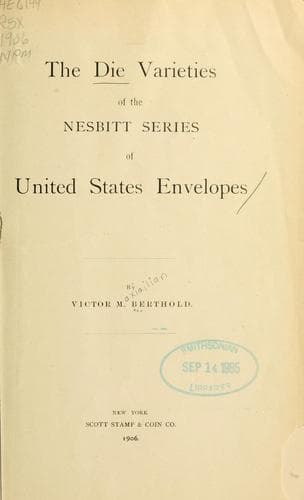
The Die Varieties of the Nesbitt Series of United States EnvelopesBerthold, Victor Maximilian
History
The Die Varieties of the Nesbitt Series of United States Envelopes
Berthold, Victor Maximilian
Postage stamps -- United States
The next we hear of the matter is a short line in the Report of the
Postmaster-General, dated December 4, 1852, which reads: "Such
envelopes as are authorized are now in preparation and will soon be
issued." And, in February of the following year, the _Scientific
American_ mentions the interesting news that "G. F. Nesbitt has shown
to the Postmaster-General an embossed stamp for prepaid envelopes which
has been accepted, and the manufacture will at once proceed. Such,
however, is the labor and care required for their production, that none
will be ready for delivery before the middle of next April."
The much heralded novelty of the Post Office finally appeared July 7,
1853. At least, this date is certified to by the National Intelligencer
of the _Washington Journal_, which, in describing the envelopes just
sent out for distribution, states: "they are as yet but of a single
size and of the three cent value." It also adds that the addition of
the Nesbitt seal is an outrage.
Without entering into further details, it is of general interest to
note that, up to 1869, Geo. F. Nesbitt & Co., of New York, continued to
furnish the United States Post Office Department with envelopes.
Recalling the fact that Nesbitt originated the dies; that the machinery
for embossing was very crude compared with our modern apparatus,
collectors must concede that his work deserves great credit.
The question, however, of superlative interest to philatelists is: why
has Nesbitt produced such a large number of dies or die varieties? The
answer is simple: Pressed hard by the Department to manufacture several
millions of envelopes, a gigantic task in the early days of stamp
making, and lacking our present means of reproducing working dies from
the matrix, he undoubtedly used his best effort; i.e. he probably
ordered a number of engravers to reproduce the original die, and, in
the hurry of the work, little attention was paid to exactness. This
would seem a very plausible explanation, and in the absence of any
official data let us permit the above assumption to stand.
Whatever may be the facts in the case, one thing is certain; the
varieties exist and have been a source of trouble to many collectors of
United States envelopes. With wider knowledge and on better
acquaintance, it is certain that in future they will prove a most
interesting branch of United States philately.
DIE I.
[Illustration]
Short labels with curved ends close to the letters. 10 loops in left
side ornament and 9 in right.
TEN HEADS--TWELVE VARIETIES.
Public-domain text, read in full here on John Shaqi.
Reviews
Reviews
No reviews yet
Be the first to share your thoughts on this work.
Join the Discussion
Join the discussion
Sign in to leave a comment or review.
Sign InorCreate an account