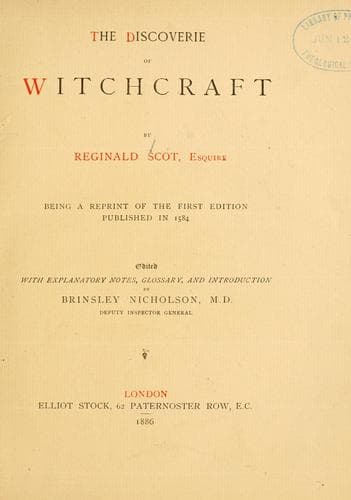
Demonology -- Early works to 1800; Magic -- Early works to 1800; Witchcraft -- Early works to 1800
[§] “Envied”, most probably in its then frequent sense of hated.
Before returning to Richard and Reginald, we may conclude this short
notice of their ancestors by mentioning the very probable circumstance
that the former were, by the female line, descendants of John Gower,
the poet, as explained in the following table:
Sir John Pashell==Elizabeth, d. of Richard Wydeville, sister of Earl
| Rivers, aunt of Edward IV’s wife.
+---------+
|
John Pashell,==1. Ludovic (Lowys), d. of Th. Gower, ob.
ob. _circa_ 1472. | _circa_ 1458.
+-------------+------------+
| |
William, Elizabeth, or Isabel,==Reg. Pympe.
ob. _ante_ 1485, _s.p._ ob. _ante_ 1485. |
+------------------------------------+
|
Anne = Sir John Scot, father of Richard Scot.
The Pashells, or Pashleys, were descended from Sir Edmund de Passelege,
a Baron of the Exchequer, who purchased a manor in Smeeth in 1319; he
died 1327. The family resided at Iden, Sussex; and the house there,
and the manor in Smeeth, devolved on the Scots, Anne Pympe being
her father’s only child. It is true that John Gower, the poet, does
not mention any children in his extant will, but he was probably
seventy-eight when he died; and, what is more to the purpose, his
published will was probably only his testament, the will or declaration
of uses of the land being commonly at that time a separate instrument.
Th. Gower, of Clapham, given above as the father of Lowys, was probably
the son or grandson of John Gower (see Sir Harris Nicolas in _The
Retrosp. Rev._, 2 Ser., ii, 103-17). Also Gower the poet is known to
have had property in Southwark; and Th. Gower, of Clapham, refers in
his will (1458) to his tenement called The Falcon, in Southwark, near
the hospital; and in Manning and Bray’s _Surrey_, iii, 623, there is
noticed a deed of conveyance dated 22nd November 1506, of part of the
site of St. Thomas’s Hospital, in Southwark, made by John Scot, of
Iden, and Anne his wife, daughter and heir of John Pashley, who was
cousin and heir of John Gower. It may be added as curious that Sir
Robert Gower, who is believed to have been uncle to the poet, was
buried in Brabourne church in 1349; his monument, now destroyed, being
noticed in Weever.
On p. 500, Scot speaks of “his kinseman M. Deering”, Edw. Dering the
divine, a writer on theological subjects and chaplain to her Majesty;
but in what way they were kin I have been unable to discover.[*]
Public-domain text, read in full here on John Shaqi.
Reviews
Reviews
No reviews yet
Be the first to share your thoughts on this work.
Join the Discussion
Join the discussion
Sign in to leave a comment or review.
Sign InorCreate an account