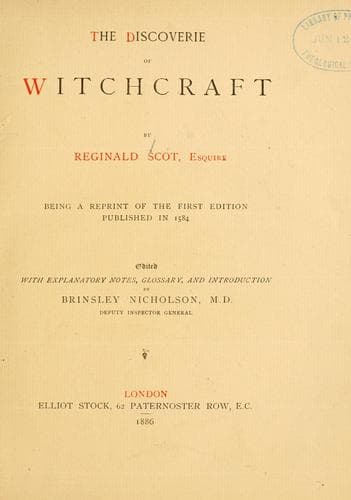
Demonology -- Early works to 1800; Magic -- Early works to 1800; Witchcraft -- Early works to 1800
written to be affixed to the handsome tomb erected over his remains.
Hence a third probability; but beyond the accumulated force of these we
cannot go.
_Epitaph on Sir Thomas Scott, as given in the “Memorials of the Scott
Family”, and also in Pick’s “Collection of Curious Pieces in the
World”, vol. 3._
Here lyes Sir Thomas Scott by name;
Oh happie Kempe that bore him!
Sir Raynold, with four knights of fame,
Lyv’d lyneally before him.
His wieves were Baker, Heyman, Beere;
His love to them unfayned.
He lyved nyne and fiftie yeare,
And seventeen soules he gayned.
His first wief bore them every one;
The world might not have myst her![*]
She was a very paragon
The Lady Buckherst’s syster.
His widow lyves in sober sort,
No matron more discreeter;
She still reteiynes a good report,
And is a great housekeeper.
He (being called to special place)
Did what might best behove him.
The Queen of England gave him grace,
The King of Heav’n did love him.
His men and tenants wail’d the daye,
His Kinne and countrie[†] cryed;
Both young and old in Kent may saye,
Woe worth the day he dyed.
He made his porter shut his gate
To sycophants and briebors,
And ope it wide to great estates,
And also to his neighbours.
His House was rightly termed Hall
Whose bred and beefe was redie;
It was a very hospitall
And refuge for the needie.
From whence he never stept aside,
In winter nor in summer;
In Christmas time he did provide
Good cheer for every comer.
When any service shold be doun,
He lyked not to lyngar;
The rich would ride, the poor wold runn,
If he held up his fingar.
He kept tall men, he rydd great hors,
He did write most finely;
He used fewe words, but cold discours
Both wysely and dyvinely.
His lyving meane,[‡] his charges greate,
His daughters well bestowed;
Although that he were left in debt,
In fine he nothing owed.
But dyed in rich and happie state,
Beloved of man and woman
And (what is yeate much more than that)
He was envied[§] of no man.
In justice he did much excell,
In law he never wrangled:
He loved rellygion wondrous well,
But he was not new-fangled.
Let Romney Marsh and Dover saye;
Ask Norborne camp at leyseur;
If he were woont to make delaye
To doe his countrie pleasure.
But Ashford’s proffer passeth all—
It was both rare and gentle;
They would have pay’d his funerall
T’ have toomb’d him in their temple.
[*] Though a paragon, she lived, he would say, a quiet, retired life,
obedient and loving to her husband.
[†] “Countrie”, seems not unlikely to be used here, as in the
_Discoverie_ not unfrequently, and twice in Wood’s notice just given,
and, as then, for county.
[‡] “Meane”, that is, moderate, midway between the very rich and the
poor.
Public-domain text, read in full here on John Shaqi.
Reviews
Reviews
No reviews yet
Be the first to share your thoughts on this work.
Join the Discussion
Join the discussion
Sign in to leave a comment or review.
Sign InorCreate an account