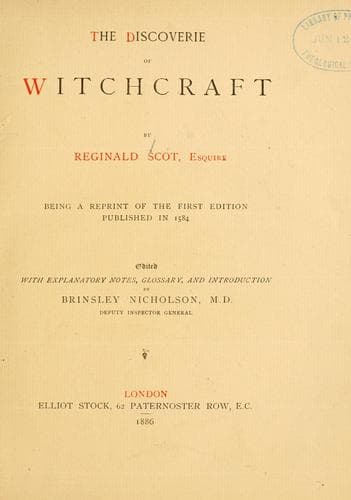
Demonology -- Early works to 1800; Magic -- Early works to 1800; Witchcraft -- Early works to 1800
How then came he to inquire into and write so strongly against
witchcraft? Before the time of the eighth Henry, sorcerers were dealt
with by the ecclesiastical law, which punished them as heretics.
Moreover, their supposed offences against the person seem, chiefly
at least, to have been taken notice of when they were supposed to
interfere with high or state matters or persons, as in the cases of
Joan of Arc or Dame Eleanor Cobham. But in Henry’s time, probably
through the extension of continental ideas, aided, it may be, by a
desire to restrain the ecclesiastical power, c. 8 of the thirty-third
year of his reign was passed. By this it was enacted, that witches,
etc., who destroyed their neighbours, and made pictures [images] of
them for magical purposes, or for the same purposes made crowns,
swords, and the like, or pulled down crosses, or declared where things
lost or stolen were become, should suffer death and loss of lands and
goods, as felons, and lose the privileges of clergy and sanctuary.
Afterwards, by 1 Edw. I, c. 12, this and other offences first made
felonies in Henry’s time were no longer to be accounted such. Thirdly,
in the fifth year of Elizabeth, Parliament, by its twelfth chapter,
enacted, that whereas many have practised sorceries to the destruction
of people and their goods, those that cause death shall suffer as was
declared by 33 Henry VIII, c. 8, except that their wives and heirs
shall not have their rights affected by such attainder. But that when
a person was only injured, or their goods or cattle destroyed, the
offenders should for the first offence suffer a year’s imprisonment,
and once a quarter be exposed in the pillory in a market town for six
hours, and there confess their offences; and for the second offence
suffer death as felons, with the exceptions before rehearsed. While
any who seek treasure, or would bring about unlawful love, or hurt
anyone in his body or goods, should for a first offence be imprisoned
and suffer as before, and for a second be imprisoned for life and
forfeit his goods and cattle. This, so far as humanity is concerned,
is a distinct advance on Henry’s enactment, though an apparent going
back from that of Edward. Perhaps, as before, it arose from a desire
to remove the offences from the jurisdiction of the ecclesiastical
law, which would have burnt them, nor, as evidenced by its little
results, does it seem to have been made through any mania or scare in
the matter. This came on later, when, as we are told by Brian Darcie
in 1582, at what time, under pie-crust promises of favour, he was
endeavouring to get women to confess, and then be hanged,—“there is a
man of great learning and knowledge come over lately into our Queenes
Majestie, which hath advertised her what a companie and numbers of
Witches be within Englande: whereupon I and other of her Justices have
received Commission for the apprehending of as many as are within these
Public-domain text, read in full here on John Shaqi.
Reviews
Reviews
No reviews yet
Be the first to share your thoughts on this work.
Join the Discussion
Join the discussion
Sign in to leave a comment or review.
Sign InorCreate an account