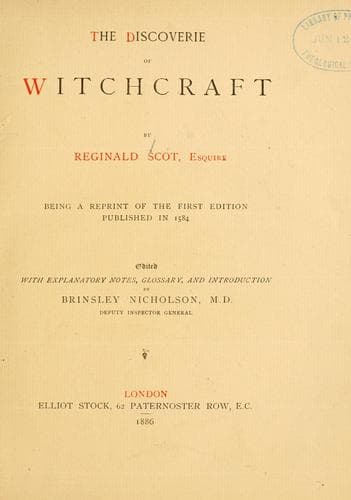
Demonology -- Early works to 1800; Magic -- Early works to 1800; Witchcraft -- Early works to 1800
The _Romans_, even after they were growne to great civilitie, and
enjoied a most flourishing state and commonwealth, would sometimes
sacrifice themselves, sometimes their children, sometimes their
friends, &c: consuming the same with fier, which they thought holie.
Such estimation (I saie) was attributed to this art of divination upon
the entrails of beasts, &c: at _Rome_, as the cheefe princes themselves
exercised the same; namelie, _Romulus_, _Fabius Maximus_, _&c_: in
so much as there was a decree made there, by the whole senate, that
six of the cheefe magistrats sonnes should from time to time be put
foorth, to learne the mysterie of these arts of augurie and divination,
at _Hetruria_, where the cunning and knowledge thereof most abounded.
When they came home well informed and instructed in this art, their
estimation and dignitie was such, as they were accounted, reputed, and
taken to be the interpreters of the gods, or rather betweene the gods
and them. No high preest, nor anie other great officer was elected, but
these did either absolutelie nominate them, or else did exhibit the
names of two, whereof the senate must choose the one.
In their ancient lawes were written these words: _Prodigia & portenta
ad Hetruscos aruspices (si senatus jusserit) deferunto, Hetruriæq;
principes disciplinam discunto. Quibus divis decreverunt, procuranto,
iisdem fulgura & ostenta pianto, auspicia servanto, auguri parento_:
the effect of which words is this; Let all prodigious and portentous
matters be carried to the soothsaiers of _Hetruria_, at the will
and commandement of the senat; and let the yoong princes be sent to
_Hetruria_, there to learne that discipline, or to be instructed in
that art and knowledge. Let there be alwaies some solicitor, to learne
with what gods they have decreed or determined their matters, and let
sacrifices be made unto them in times of lightening, or at anie strange
or supernaturall shew. Let all such conjecturing tokens be observed;
whatsoever the soothsaier commandeth, let it be religiouslie obeied.
♦The lawe of the twelve tables.♦
The sixt Chapter.
_Colleges of augurors, their office, their number, the
signification of augurie, that the practisers of that art
were couseners, their profession, their places of exercise,
their apparrell, their superstition._
_Romulus_ erected three colleges or centuries of those kinds of
soothsaiers, which onelie (and none other) should have authoritie to
expound the minds and admonishments of the gods. Afterwards that number
was augmented to five, and after that to nine: for they must needs be
od. In the end, they increased so fast, that they were feine to make
a decree for staie from the further proceeding in those erections:
like to our statute of _Mortmaine_. Howbeit, _Silla_ (contrarie to all
orders and constitutions before made) increased that number to foure
and twentie.
♦_Magna charta. Hen. 3. 36. 7 Ed. 1. 15. Ri. 2. 5._♦
Public-domain text, read in full here on John Shaqi.
Reviews
Reviews
No reviews yet
Be the first to share your thoughts on this work.
Elsewhere in the archive
Join the Discussion
Join the discussion
Sign in to leave a comment or review.
Sign InorCreate an account