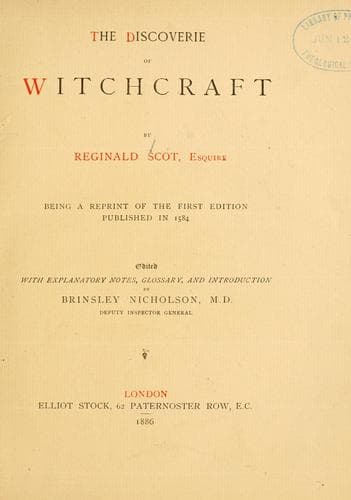
Demonology -- Early works to 1800; Magic -- Early works to 1800; Witchcraft -- Early works to 1800
It thus appears that though Scot may have been brought up in a
traditional but little-regarded belief in witchcraft, he, when he was
at least thirty-four, was not only unprepared, but startled, to witness
and take part in this new departure from justice and mercy. Witchcraft,
chiefly looked on as useful in discovering things lost, or in bringing
a wished-for sweetheart to return the love of the seeker, or in curing
ailments simple or grievous, became feared, reviled, and sought out:
sought out by Commission of the Queen, sought out by the people as a
great and fearful evil rapidly overspreading the land, and able and
willing, like the Plague and Black Death, to count its victims by
thousands, and from the cottage to the throne itself. He, a man both
intelligent and compassionate, sees poor, old, decrepit creatures eking
out a miserable livelihood by begging an occasional dole from their
better off neighbours; ill-tempered by age and condition, and therefore
abusive when refused such dole, or on slighter causes, sometimes
perhaps through old knowledge or superstition, but probably more often
for the sake of gain, pretending to be wise above what is known; he
sees these accused of selling their souls for the sake of such a
position in the world, he hears them accused sometimes of foul, more
frequently of unlikely, crimes and acts, nay, such as an unprejudiced
common sense must laugh at, while the evidence is nearly always so
faulty that, were the accusation a different one, it would be at once
turned inside out and thrown aside. Unfortunately, too, some of these
old women being more or less mad, and others driven through fear on the
one hand, or through promised favour on the other, confess themselves
capable of doing these things, though any man of sense and observation
could detect their state or motives. Luckily, too, he had had close to
him, and in his wife’s family, the known and talked-of imposture of the
Holy Maid of Kent; and in his own time and close to his own door, the
case of the Pythonist of Westwell, at first carried out triumphantly,
and then, on her own confession and her re-acted acts, branded as an
impostor, like the Holy Maid. The Dutchman, too, at Maidstone, after
being set forth as a worker of miracles and an exorcist, was found to
be a rogue; and “manie other such miracles had beene latelie printed,
whereof diverse had beene bewraied.” He had taken part also—apparently
as one engaged for the defence—in that piece of folly called the trial
of Margaret Simons, and knew the history of Ade Davie, and of her
restoration to sanity without exorcism, hanging, or burning.
Public-domain text, read in full here on John Shaqi.
Reviews
Reviews
No reviews yet
Be the first to share your thoughts on this work.
Join the Discussion
Join the discussion
Sign in to leave a comment or review.
Sign InorCreate an account