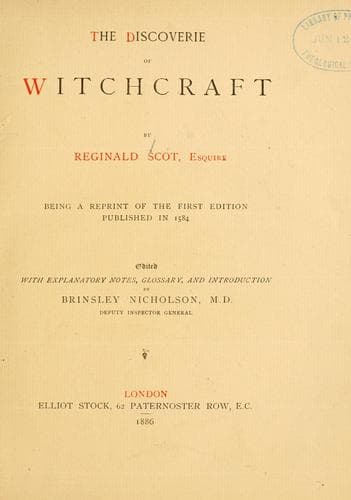
Demonology -- Early works to 1800; Magic -- Early works to 1800; Witchcraft -- Early works to 1800
These facts, and especially this last, aroused, I believe, Scot’s
compassion and indignation, and made both find vent in printed words.
And besides these likelihoods, including that of date, there are two
at first sight seemingly contradictory facts, which made themselves
manifest to me when I first carefully read the book, and before I
had formed any opinion on their causes, and which are on this view
reconciled. These facts are, that while the plan which he has adopted,
and his facts and conclusions, seem to have been deliberately sought
out, thought over, and canvassed, there are evidences throughout of
a feverous haste of composition, such feverous haste as the above
spoken of emotions would excite in a man like Scot, who had witnessed
so horrible and so bloody a perversion of justice. The proof of the
first fact I leave to be observed by the intelligent reader; but while
the second must also be observed by him, it is needful, to the full
exposition of my argument, that I should collect in one view most at
least of the details. This haste is evidenced in some of his corrected
errata, but more in those that he did not correct. Thus we have,
on p. 174, a curious slip, by which Pharaoh becomes a Persian, and
Nebuchadnezzar takes Pharaoh’s place as an Egyptian king, for other
parts of the book prove conclusively that this was an unintentional
lapsus, and one a second time overlooked when the book was re-read
before the title-page and the preliminary leaves were set up. Similar
are his errors as to Haias and Sedaias, for at one time he speaks of
Rabbi Sedaias Haias, repeating it also at the last when he gives his
“forren authors” consulted, and between these speaks of them as two
persons, as they were. More especially would I call attention to his
blunders as to Argerius Ferrerius. He quotes him—yet he is always
Ferr_a_rius—five times in his text, twice in his table of contents, and
once in his “authors used”. So in his translation from him, the “s” of
“verbis” being indistinct in some copies, he read the word as “verbi”,
and thereby translated the sentence into such unmistakable nonsense
that this alone should have shown him his error. So, also, we have the
senseless, because careless, rendering of the sword in hand passage,
p. 257; and with these may be classed his adoption of T. R.’s curious
mistranslations from Wier’s _Pseudomonarchia_, or from another copy of
the _Empto. Salomonis_, for a moment’s consideration would have shown
him their absurdity, and led him to turn to Wier. In p. 19 also, we
find “infants” where, as stated in my note, all the editions of the
_Mal. Malef._ in the British Museum have “infames”; and this, though a
slip of memory, betokens, when taken with the rest, overhaste. These
slips, in an ordinary writer, would lead to another conclusion, but not
in this case, where we have evidence of both ordinary and recondite
knowledge, of conclusions tried by actual experiment, of a quick and
Public-domain text, read in full here on John Shaqi.
Reviews
Reviews
No reviews yet
Be the first to share your thoughts on this work.
Join the Discussion
Join the discussion
Sign in to leave a comment or review.
Sign InorCreate an account