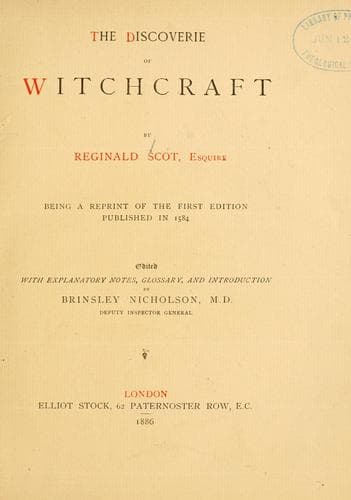
Demonology -- Early works to 1800; Magic -- Early works to 1800; Witchcraft -- Early works to 1800
intelligent perception, and of what may be called, in a good sense,
a ready and acute subtlety in refuting or retorting allegations or
objections.
Our author’s indebtedness to Cornelius Agrippa and to Wier has, in a
great measure, been anticipated in what has been said; but a few words
may here be added. Casually coming across their books when he became a
reader of out-of-the-way works, he did not become a follower of theirs,
and then write a book, as the disciples of Pythagoras wrote books to
expound and hand down the doctrines of their master. Wier had written
a book against witchcraft, and a clear and comprehensive book. But
while Scot certainly followed Wier in point of time, and as certainly
was much indebted to him for the perfecting of his book, yet, as I
have said, Scot seems to have taken up his belief against the reality
of witchcraft from what he in his own experience had witnessed; and
my view, that he was then led to read Wier and Cornelius Agrippa, and
the writers on the other side, seems to me confirmed by what we find
as to his indebtedness to Wier. The “Notings on Wier” show that, while
he copied him in some other instances, he borrowed from him mainly
a long list of illustrations, some of which even he may have drawn
independently from the same sources as did Wier.
_Bibliography._—We do not find an entry of Scot’s _Hoppe-garden_ in the
Stationers’ Registers, because the entries about 1574 are wanting. But
why do we not find so large and important a book as the _Witchcraft_
of 1584 so entered, the writer being of a family of no mean repute,
and the head of his house, Sir Th. Scot, being in those days a man
of some mark? The answer, after what has been said, is simple. He
upheld and defended a heresy, the existence and diabolical powers and
practices of witches being believed in and guarded against, by the
Queen, the bishops, and the people. Hence the reply of the Stationers’
Company would most certainly have been—the same as in more trifling
cases—“provided he shall get the bishop of London his alowance to
yt”, words which, under the circumstances, would have been a refusal,
and a refusal which, had any steps been taken against him after its
publication, would have told against him. Hence he resolved to print
it, taking all the blame and responsibility on his own shoulders, no
stationer’s name being connected with it, and the name of the printer
appearing only at the end of the book, without date or place of
address—“Imprinted at London by | _William Brome_.” And here, by the
way, it may be mentioned that though called in catalogues a quarto, its
signatures are in eights. As before stated, both Thomas Ady and Anthony
à Wood tell us that it “did for a time make great impressions on the
Magistracy and Clergy”, and that it did so generally is shown by the
appearance of Webster’s, Ady’s, and other books on the same side, and
those of Gifford, Perkins, and others, on the other, including King
Public-domain text, read in full here on John Shaqi.
Reviews
Reviews
No reviews yet
Be the first to share your thoughts on this work.
Join the Discussion
Join the discussion
Sign in to leave a comment or review.
Sign InorCreate an account