Demonology -- Early works to 1800; Magic -- Early works to 1800; Witchcraft -- Early works to 1800
269, 16. “If there be masses _delete_ If.” Retained, but the second
attempts to correct by inserting “no” before “masses”, and the third
follows suit, though it is as nonsensical as before.
463, 16. “Their business _read_ that business.” Not corrected.
Beyond these, the limited edition now printed is the only other known
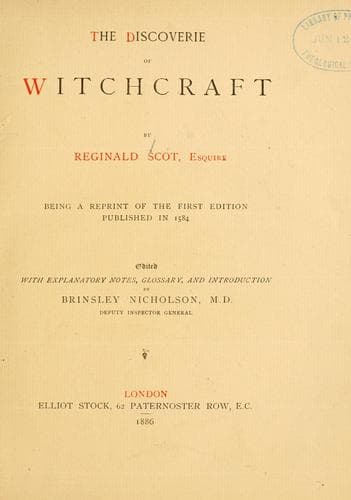
to me. As stated in the preface, it is a reprint of the first edition,
with some slight alterations in the lettering, but not in the spelling.
Besides the few errata that have been found and recorded, the small
heading on its left hand pages up to p. 24 is “Chap. —”, like that on
the right hand, instead of being “1 or 2 Booke”. So also in
the earlier pages, the marginal references, though correct, are not
printed line for line with the original. The pictorial initial letters
of the first chapter of each book occupy in the original almost a
third of the page. The first word of a chapter has only its first two
letters—including its pictorial letter—in capitals, but the remainder,
as well as the rest of the first line, is in larger type than the
rest. The original being also in black letter was enabled to use both
Romans and Italics as variants, whereas the reprint could only use
Italics. The rule of the original is, however, in general very simple.
“The — Chapter”, the contents of the chapter and proper names are in
Romans; “The — Booke” and quotations in Italics; the translations of
quotations in Romans. Wherever there can be any doubt the type of the
original is marked in the margin, as are occasional uses by the author
of [] to distinguish them from the editor’s use of the same. It may be
added that “The — Chapter”, and the contents of the chapter, have been
transposed. The V like arrangement of the lines at the end of a chapter
have not been followed, but been imitated according to the spirit in
which they were employed; for, after an investigation made for the
purpose, it was found that they do not indicate a division of the text
or matter, but were simply compositors’ devices to fill up a page when
that page either ended a book, or when its blank space did not allow
of the commencement of a new chapter. Similarly, on one page, a (∵)
was added to complete the page. And, in like manner, if there was still
space at the end of a book, an engraving was inserted. I would add
that all the page references that I make are to the pages of the 1584
edition.
Public-domain text, read in full here on John Shaqi.
Reviews
Reviews
No reviews yet
Be the first to share your thoughts on this work.
Join the Discussion
Join the discussion
Sign in to leave a comment or review.
Sign InorCreate an account