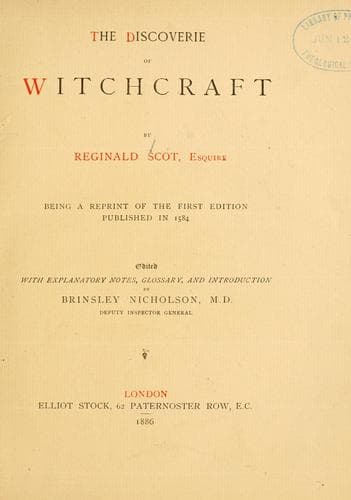
Demonology -- Early works to 1800; Magic -- Early works to 1800; Witchcraft -- Early works to 1800
I had collected for an appendix various grammatical peculiarities of
the age; but they increased the number of pages, and therefore the
price of the book, without, as seemed to me, sufficient cause, more
especially as the reader can readily consult Dr. Abbot’s _Shakesperian
Grammar_, as well as notices in other books. One point, however, ought
to be attended to. Though an educated and University man, accustomed to
Latin and Greek, he, like all of his time, followed the then frequent
habit of using singular verbs after plural nominatives not immediately
preceding them. A close examination of these, both in Scot and Greene,
another literate and Utriusque Academiæ in Artibus Magister; and one
notable one in Ben Jonson, who elsewhere, so far as I know, avoids this
error; as well as those in Shakespeare and others, have shown me that
they cannot be explained as is sought in Dr. Abbot’s _Shakesperian
Grammar_, § 333, where the form of the verb is held to be a remnant of
the northern early English third person plural in “s”. The instances
alone of the auxiliary verbs so used set this theory aside, and show
that the custom was due to carelessness, habit, the remoteness or after
position of the true nominatives, and to the nearness of another word,
sometimes even to a transposed objective; or of a “that” or “which”
that had the look of a singular, or in the case of a double nominative,
to both words being considered as implying one thought, as indeed they
often did, being merely synonyms. Our Elizabethan ancestors would
have said: “Pity and compassion moves me,” because they held pity
and compassion were one and the same; and the habit of using Saxon
and Latin, or other synonyms, led them to use the same construction
when the meanings were but allied. This seems to me the more likely
explanation: but the reader may prefer this—that our ancestors took the
phrase to be elliptical, and that the verb really employed after both
substantives was to be understood after the first and before the “and”.
Public-domain text, read in full here on John Shaqi.
Reviews
Reviews
No reviews yet
Be the first to share your thoughts on this work.
Join the Discussion
Join the discussion
Sign in to leave a comment or review.
Sign InorCreate an account