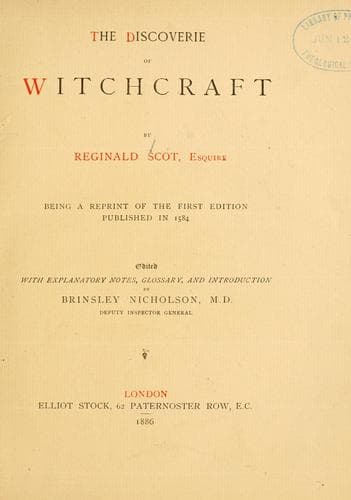
Demonology -- Early works to 1800; Magic -- Early works to 1800; Witchcraft -- Early works to 1800
I have said on p. _xxii_ that the discovery of Scot’s name in the
Subsidy Rolls for 1586 and 1587 with the affix of “Armiger” was for me
an important find. And now I would explain that it was so, inasmuch
as it set my mind at rest as to the oneness of the Raynold of the
_Hoppe-garden_ with the Reginald Scot Esquire, of the _Witchcraft_.
Aware that Reynold and Reginald were variants of one name, used of
and by the same person, the following facts hindered me for a long
time from accepting the common belief that the Raynold and Reginald
of these two works were one and the same. First, the author of the
_Hoppe-garden_ in each of his signatures to the editions of 1574-6-8,
three in each, appears as Raynold. In the marriage entry, in the
pay-account of the Kent forces, in the Muster-roll, and in the Will,
it is also Raynold. But in 1584, throughout the _Witchcraft_, that is,
four times in all, the name appears as Reginald. Secondly, in the Will
of 1599, in accordance with the want of any title on the title-page
of the _Hoppe-garden_, he describes himself as “gent”, and in the
Inquisitio p. m., though he is called Reginald, the document being in
Latin, he is, as in his Will, “generosus”. But in the title-page of
the _Witchcraft_, he is Reginald Scot Esquire. The finding no evidence
of the separate existence of a Raynold and a Reginald, the frequent
references to the Scriptures in the _Witchcraft_, and the very frequent
references to the Proverbs and Ecclesiastes, in the “Address to the
Reader” of the _Hoppe-garden_, the use in both works, as already
quoted, of certain legal phrases, and the occurrence in the prefatory
part of the _Hoppe-garden_ of “with the licour (or rather the lucre)”,
and “condemne the man, or rather the mynde”, a trick of language not
unfrequently repeated in the _Discoverie_, a trick resulting from his
love of irony, shook my doubts. But there were still, the want of any
title after the name in the _Hoppe-garden_, the “gent” of the Will,
and the “generosus” of the Inquisitio, as against the “Esquire” of the
_Discoverie_. First, however, Hunter’s suggestion, that his esquireship
was due to his having been appointed a Justice of the Peace, and then
the discovery of armiger after his name, have removed all reasonable
doubts; and to turn our belief to a positive certainty, it only remains
to discover that he was a Justice of the Peace.
Public-domain text, read in full here on John Shaqi.
Reviews
Reviews
No reviews yet
Be the first to share your thoughts on this work.
Join the Discussion
Join the discussion
Sign in to leave a comment or review.
Sign InorCreate an account