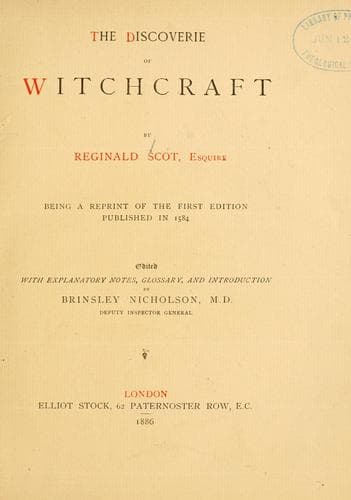
Demonology -- Early works to 1800; Magic -- Early works to 1800; Witchcraft -- Early works to 1800
_Contemporary Notices of Scot._—Of strictly contemporary notices, I
know of but two. In Nash’s _Four Letters Confuted_, 1593, he asks, ed.
Grosart, ii, 252: “How is the _Supplication_ a diabolicall Discourse,
otherwise than as it intreats of the diverse natures and properties
of Divels and spirits? in that far fetcht sense may the famous
_defensative against supposed Prophecies_, and _the Discoverie of
Witchcraft_ be called notorious Diabolicall discourses, as well as the
_Supplication_, for they also intreate of the illusions and sundrie
operations of spirits.” The second is in Gabriel Harvey’s _Pierce’s
Supererogation_, 1593, ed. Grosart, ii, 291: “Scottes discoovery of
Witchcraft, dismasketh sundry egregious impostures, and in certaine
principall Chapters, & speciall passages, hitteth the nayle on the head
with a witnesse: howsoever I could have wished, [G. H. is nothing if
he be not quasi-critical and emending] he had either dealt somewhat
more curteously with Monsieur Bodine, or cōfuted him somewhat more
effectually.”
Of course, various of the after-writers on witchcraft, whichever
side they took, either spoke of him explicitly, or alluded to him;
Webster, Wagstaffe, Ady, and others, on the same side as Scot, and
Meric Casaubon, Cotta, etc., ending with Glanvil on the other. But
these, the really curious in such matters may be left to search out
for themselves. Only I would like to mention John Deacon’s and John
Walker’s _Dialogicall Discourses of ... Devils_ [etc.], 1601, both
because they, being clergymen, had the boldness—besides adding new
arguments of their own, and though their wording is somewhat less
decided than their own evident belief—out of three explanations of the
case of the Witch of Endor which they set before the reader, to plainly
prefer Scot’s view of her ventriloquism, both naming him in the text,
and giving the reference to his page in their margin; and secondly,
because so far as a hasty look enables one to give an opinion, they
spoke more rationally on magical and other points than one would at
that date expect. They also quote the opinion of Hippocrates on magical
cures, as given by Scot, p. 450, and show that they take it, though
not literally, from him, and not from Hippocrates directly, by giving
a reference to Scot in the margin. Afterwards they published in 1603,
a second large work, _A summarie_[?] _answer to John Darrell_, the
first work having been also suggested by the same impostor, and his
setting forth of himself as a caster out of devils.
Public-domain text, read in full here on John Shaqi.
Reviews
Reviews
No reviews yet
Be the first to share your thoughts on this work.
Join the Discussion
Join the discussion
Sign in to leave a comment or review.
Sign InorCreate an account