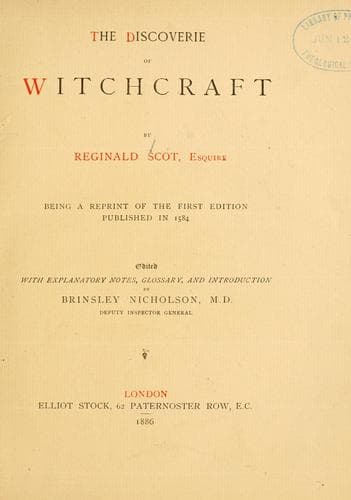
Demonology -- Early works to 1800; Magic -- Early works to 1800; Witchcraft -- Early works to 1800
and the Barons of Burley in Scotland, who derive themselves originally
from _Balioll_, are known at this instant by no other Sirname, but
Scot, and bear with some inconsiderable Difference, those very Arms
which are at present the paternal Coat of the Family of _Scots-hall_.”
This tradition excluded, we find that Sir William Scot of Braberne, now
Brabourne, in Kent, is the first of whom we have historical mention.
He was knighted in 1336, when the Black Prince was created Duke of
Cornwall, and died in 1350: a brass to his memory, being in Weever’s
time (1631), the first of the memorials of the Scot family in Brabourne
church. According to Philipot, this Sir William was the same with Sir
William Scot, then Chief Justice of England; but if Mr. Foss be right
in stating that this latter died in 1346, the year of the Black Death,
this view cannot be upheld.
Another Sir William, apparently a grandson of the above, acquired
through his mother the manor of Combe in Brabourne, and through his
first wife and her relations—modes of increase in which the family seem
to have been fortunate—that of Orlestone, as well as other places;
and in 1420 he built Scotshall, in the manor of Hall in Smeeth, and
was in 1428 sheriff of the county, and in 1430 knight of the shire in
parliament. He died 1433. Scotshall, from time to time enlarged or
rebuilt, and especially so by Sir Edward Scot, in the reign of Charles
I, became the family seat for twelve generations. Evelyn, under date
August 2, 1663, records his visit to it (soon after the young knight’s
marriage), and calls it “a right noble seate, uniformely built, with
a handsome gallery. It stands in a park well stor’d, the land fat and
good. We were exceedingly feasted by the young knight, and in his
pretty chapell heard an excellent sermon by his chaplaine.” It was
sold, with the remaining possessions of the family, at the close of the
last century, and destroyed in 1808. Some undulations in a field on the
north side of the road from Ashford to Hythe, about half a mile to the
east of Smeeth church, alone mark its site.
The son of this second Sir William, named Sir John, being connected
with the Woodvilles, and therefore with the wife of Edward IV, and
being a staunch Yorkist, and apparently a man of intelligence, was
employed in special embassies to Charles, Duke of Burgundy, especially
in 1467, when he went to treat of the marriage of the king’s sister
with the duke. He had also various other and more substantial favours
conferred upon him from time to time, from 1461 onwards, including that
of Chilham Castle for life, as somewhat oddly, and I think wrongly,
noted in the extract from Philipot. He died in 1485, and probably
intestate, as no will is recorded.
Public-domain text, read in full here on John Shaqi.
Reviews
Reviews
No reviews yet
Be the first to share your thoughts on this work.
Join the Discussion
Join the discussion
Sign in to leave a comment or review.
Sign InorCreate an account