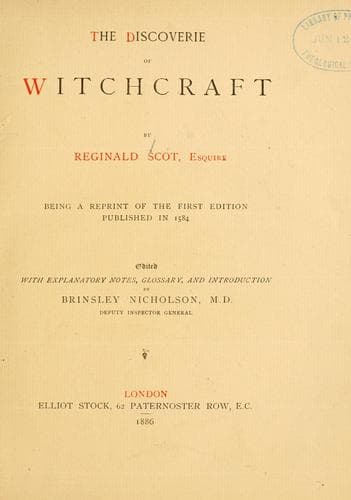
Demonology -- Early works to 1800; Magic -- Early works to 1800; Witchcraft -- Early works to 1800
To him succeeded his son, the third Sir William in this account, and
he dying in 1524, was succeeded by his son, a second Sir John. This
last, by his marriage with Anne, daughter of Reginald Pympe, had three
sons, and died on the 7th October 1533. The eldest, William, followed
his father on the 5th June 1536, and leaving no offspring, his next
brother, Sir Reginald, took his place. Of the third brother, Richard,
the father of our Reginald, I shall speak presently. Meanwhile,
returning to the main line, I would say that Sir Reginald, dying on
the 16th October 1554, was succeeded by his son, Sir Thomas, the
“cousin” to whom Reginald was much indebted, and one of the four to
whom he dedicated his _Witchcraft_. He was, in his day, a man of note,
intelligence, and action. Finding his estate in debt, he yet kept one
hundred at his table, was most hospitable, and died owing nothing,
though, of course, to provide for the younger of his very numerous
progeny, various portions of his estate were by his will sold after
his death. He was deputy-lieutenant of his county, sheriff of Kent in
1576, knight of the shire for the Parliaments of 13 and 28 Elizabeth,
chief of the Kentish forces at Northbourne Downs, where they were
assembled to repel any landing from the Armada; and it may be added,
as showing his promptness, readiness, and decision, that 4,000 of
these were there, equipped for the field, the day after he received
his orders from the Privy Council. He was one of the Commissioners to
report on the advisability of improving the breed of horses in this
country, and either before or after this, is said to have published a
book on the subject. He was a Commissioner for draining and improving
Romney Marsh, and afterwards Superintendent of the improvements of
Dover harbour. Various letters to and from him in reference to Dover
harbour, as well as to the Kentish forces, are to be found in the
State Calendars. Having been the parent of seventeen children by his
first wife, Emmeline Kempe, a relative by maternal descent, he died
on the 30th December 1594, and Ashford parish offered to pay the
expenses of his funeral if only they were allowed to bury him in their
church. Most of these facts are noted in the following verses, which
I give, chiefly because there are some probabilities that they were
by Reginald. A copy of them seems to have been found among the family
papers, in his handwriting. That he made some of the verse translations
given in his _Witchcraft_ is extremely probable, from the want in these
cases of marginal references to the translator’s name; hence a second
probability. The verses themselves render it likely that they were
one of those memorial elegies then affixed επι ταϕον by affectionate
friends and relatives, and not what we now call an epitaph; and the
third verse clearly shows that they were written at least some little
time after Sir Thomas’s decease, and therefore were not improbably
Public-domain text, read in full here on John Shaqi.
Reviews
Reviews
No reviews yet
Be the first to share your thoughts on this work.
Join the Discussion
Join the discussion
Sign in to leave a comment or review.
Sign InorCreate an account