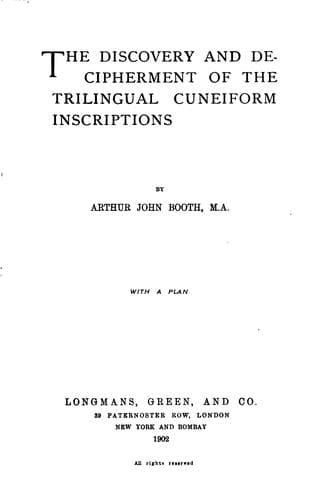
The discovery and decipherment of the trilingual cuneiform inscriptionsBooth, Arthur John
History
The discovery and decipherment of the trilingual cuneiform inscriptions
Booth, Arthur John
Achaemenian inscriptions; Cuneiform inscriptions
The palaces stand upon an artificial terrace of their own raised above
the level of the platform, and the stairs leading up to them have
afforded an opportunity for the display of ornamentation in bas-relief.
The Porch is invariably protected by colossal guards hewn out of the
stone. Over the great door of the main entrances the king is depicted
entering or leaving the building, with attendants bearing the royal
parasol and fly-chaser. On the doors leading to the lateral chambers he
may be seen in dignified conflict with wild animals; or, as in the Palace
of Xerxes, these scenes are replaced by attendants bearing viands to the
royal table. Some of the most elaborate designs are met in the Central
Edifice and in the Hall of the Hundred Columns. In the latter the king
appears seated in a chair of state raised above the heads of five rows of
warriors; while at the opposite door his throne is similarly supported by
three rows of figures representing subject nations. These bas-reliefs are
surrounded by an exquisite fretted fringe of roses, diversified above by
small figures of bulls and lions; and over the whole the winged figure of
Ormuzd is seen to hover.
A large inscription occupies the outside wall of the southern terrace.
It is in four tablets, known as the H, I, K and L of Niebuhr. The I
inscription enumerates the provinces of Darius: another contains the
declaration that that Terrace or Fortress was built by Darius, and,
‘before him there was not any fortress in that place.’[4] Above the
animals in the Porch is an inscription of Xerxes in three tablets,
declaring that it was erected by him, and that it was one of the many
beautiful works accomplished by him and his father Darius ‘in Parsa’
(Inscription D). The unilingual inscription on the sculptured staircase
informs us that it also was constructed by Xerxes (Inscription A). As
we ascend the south stairs to the Palace of Darius, we observe on the
façade below the landing stage three tablets of inscriptions which are
repeated upon the landing, on the anta in the south-west corner. It is
again Xerxes who speaks, but he tells us that it was Darius who erected
that palace (Inscriptions C and Cᵃ). Passing through the great doors we
observe above the king and his attendants three tablets of inscriptions.
They are in the three languages and run: ‘Darius, the great king, king
of kings, king of nations, son of Hystaspes, the Achaemenian, has built
this palace’ (Inscription B). Within, round the doors and windows is
a single-line inscription written on the top in Persian, ascending
on the left in Susian and descending on the right hand in Babylonian
(Inscription L). On the west side of this palace is a second staircase,
added later, of Artaxerxes Ochus, as we learn from a magnificent
inscription on the façade (Inscription P). This inscription is repeated
on the stairs leading to the palace of that king.[5] Adjoining the latter
is the Palace of Xerxes, approached by two principal staircases, one to
Public-domain text, read in full here on John Shaqi.
Reviews
Reviews
No reviews yet
Be the first to share your thoughts on this work.
Join the Discussion
Join the discussion
Sign in to leave a comment or review.
Sign InorCreate an account