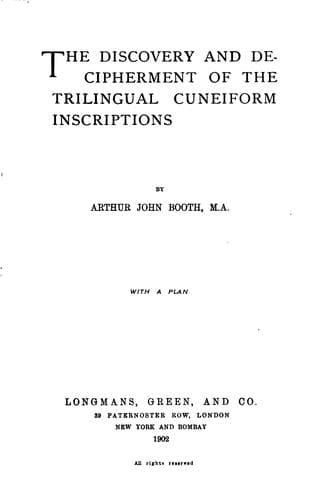
The discovery and decipherment of the trilingual cuneiform inscriptionsBooth, Arthur John
History
The discovery and decipherment of the trilingual cuneiform inscriptions
Booth, Arthur John
Achaemenian inscriptions; Cuneiform inscriptions
Some of them, indeed, he made considerably worse, and added others of his
own, so that, notwithstanding a few corrections, their number rose to
seventeen. He, however, pointed out that there was a determinative before
the words for ‘god,’ ‘Ormuzd’ and ‘heaven,’ contrary to the opinion of
Westergaard; and that the group the latter had mistaken for the vowel a
was precisely that sign. He was less successful in his classification of
the language, which he could not accept as Scythic. He considered its
affinity was with the Aryan family, but he could not find that any of the
Indo-European languages had similar inflections.[640]
A few years later De Saulcy wrote two articles in the ‘Journal Asiatique’
on the Median, without, however, making any important contribution to
the subject.[641] His papers deserve notice chiefly on account of his
eminence in other departments of study, and because he was the only
Continental writer whose attention was directed at that time to this
special branch of inquiry.[642] He thought he could recognise that it
bore a close relationship to Persian, sufficient to justify the opinion
of Strabo that the two languages were the same. Both Westergaard and
Rawlinson had already observed that some of its grammatical forms and
vocabulary could be best explained by reference to the modern Georgian
and Turkish; and De Saulcy, notwithstanding his opinion of its affinity
with Aryan, fully recognised that it had left traces in other quarters,
including Kurd, Mongol, Armenian and the Gipsy tongue, but nowhere to a
greater degree than in Turkish. He supports his opinion with a wealth of
illustration drawn from these sources that must have fairly distracted
his printer, and the indiscriminate use of the mechanism of philological
dictionaries has in fact led the writer into many serious errors. He
does not refer to Hincks, and notwithstanding all the resources at his
command, he has fallen far short of the Irish writer whose country
rectory was ill provided with these artificial appliances. De Saulcy
has not, in fact, added a single correct value to those already known,
and has failed to recognise several already established as correct. The
utmost generosity cannot concede to him the possession of more than
twenty-one correct values and nine nearly correct, all previously known;
so that he had not more than thirty available for transliteration, as
opposed to the twenty-nine of Westergaard and the forty-seven of Hincks.
But he introduced a host of errors that are wholly his own. He assigned
no less that thirty values that are absolutely wrong, although he only
attempted sixty-two out of the eighty-two in Westergaard’s list. But it
is not only in the details of decipherment that he went astray; his error
covers the whole conception of the structure of the language. He has no
less than fifteen different signs for vowels representing many fantastic
gradations of sound. Different modifications of _a_ and _ou_ monopolise
Public-domain text, read in full here on John Shaqi.
Reviews
Reviews
No reviews yet
Be the first to share your thoughts on this work.
Elsewhere in the archive
Join the Discussion
Join the discussion
Sign in to leave a comment or review.
Sign InorCreate an account