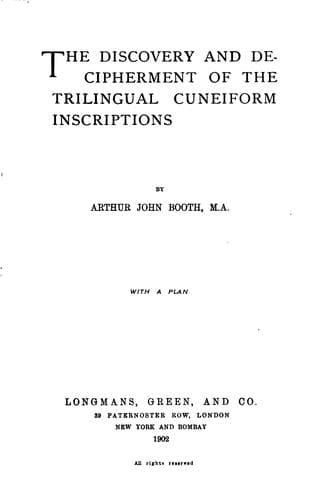
The discovery and decipherment of the trilingual cuneiform inscriptionsBooth, Arthur John
History
The discovery and decipherment of the trilingual cuneiform inscriptions
Booth, Arthur John
Achaemenian inscriptions; Cuneiform inscriptions
each three signs, besides the concession of one each for _hou_ and _ô_.
A simple _u_ is not suffered to appear; but _ha_, _he_ or _e_?, _ya_,
_aï_?, and _oui_ are classified among the vowels. Some difference still
exists as to the treatment of the vowels. The latest authority limits
them to _a_, _e_, _i_ and _u_, and excludes _o_.[643] M. Oppert ranks
_a_ or _ha_ among the consonants; and in addition to _e_, _i_ and _u_ he
admits _o_ and such sounds as _yi_, _ya_, _ah_ among vowels.[644]
But it is in the treatment of the consonants that De Saulcy has most
departed from the earliest and the latest scholars. He fully admits
the syllabic character of the language, but he has done the utmost
under the circumstances to conceal this peculiarity.[645] In his list
the only sign that appears in syllabic form is the semi-vowel _ar_
attributed to a defective sign (No. 10), and the eye already accustomed
to the appearance of syllabic combinations is struck by the singular
bareness produced by purely alphabetical letters. He admits altogether
twenty-one distinct consonantal sounds, of which fourteen are ‘quiescent’
or simple consonants, and each is represented by one sign only, except
_m_, _w_, to which three are allotted. He allows six gutturals to a
language that has at most but two, and fills the other classes with
scarcely less profusion. He recognises that the signs for _m_ and _w_
are interchangeable, and that _d_ and _t_, as well as _b_ and _p_, have
several signs common to both; but he gives both _p_ and _t_ the exclusive
use of others; and _dè_ and _dh_ have each a sign reserved to themselves.
His consonantal sounds are given different signs according as they are
supposed to be followed by _a_, by _e_ or _i_, and by _o_ or _ou_, an
idea no doubt suggested by the restricted use of the same principle in
Old Persian. These letters may be said to be practically syllabic signs,
as they are only used in conjunction with a vowel; but in reality the
classification involves serious error. It is now admitted that, with
few exceptions, the same sign never conveys the sound of more than one
vowel, and in the isolated cases where it occurs it is generally at the
end of a word. In the whole Syllabarium of Weisbach there is only one
instance where the same sign is given an optional sound of _pe_, _pat_,
and in that of Oppert there are only three where _a_ can be exchanged
for _i_.[646] In neither authority is there a single instance where _e_
and _i_ are interchangeable. It is therefore a fundamental error of the
gravest character to represent the same sign as systematically employed
to express either of two vowel sounds, even if the two selected were
ever interchangeable. It is, moreover, doubtful whether there was any
difference allowed between the sounds of _o_ and _u_, except in the
attempt to express foreign words. De Saulcy’s system also excluded the
compound syllables when two consonants are divided by a vowel. While
Public-domain text, read in full here on John Shaqi.
Reviews
Reviews
No reviews yet
Be the first to share your thoughts on this work.
Elsewhere in the archive
Join the Discussion
Join the discussion
Sign in to leave a comment or review.
Sign InorCreate an account