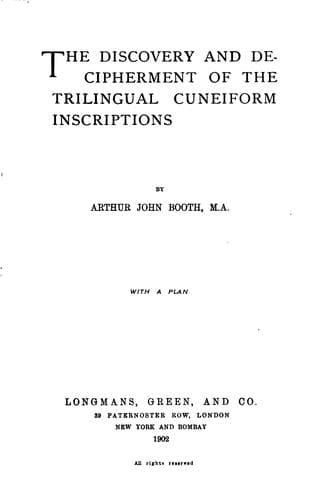
The discovery and decipherment of the trilingual cuneiform inscriptionsBooth, Arthur John
History
The discovery and decipherment of the trilingual cuneiform inscriptions
Booth, Arthur John
Achaemenian inscriptions; Cuneiform inscriptions
of the bas-reliefs, and observes that the different groups are separated
from each other by a design representing the cypress tree. The various
animals that figure in the procession lead him to think they were
intended for sacrifice, and hence that the edifice had been probably a
temple. He fixes the position of the inscriptions at the extreme end
of the procession. He is much less enthusiastic in his praise than Don
Garcia. He does not consider that the figures of men and animals, nor
those of trees, are well designed; and he thinks the beauty of the work
as a whole consists chiefly in its antiquity and in the magnificence of
the marble of which it is composed. Don Garcia had counted twenty-seven
columns, but at the time of Della Valle’s visit, only three and a half
years later, not more than twenty-five remained. As he approached from
the north he observed the traces of two rows of columns stretching from
east to west. Beyond them is a vacant space, about sufficient for two
rows of columns; and then we come to a central group of six rows of
columns arranged from north to south. On either side, to west and east
of the central group, but separated from it by the distance already
mentioned, there are double rows of columns, as on the north side. He
says nothing of any colonnade on the south, where in fact there is none.
The columns are about twenty-six and a half feet apart, and some are
higher than others, from which he inferred that the building was not
roofed, and could not therefore have been the palace of a king. He could
not find any trace of a staircase leading to an upper story.
Passing the columns and continuing in the same southerly direction, he
observed two small chambers, one on the right hand, near the edge of the
Terrace; the other on the left hand, towards the mountain. They are not
really chambers, but open courts; nor are they surrounded by walls, but
by the jambs of doors and windows. As in the Columnar Edifice, there are
no indications that the buildings were roofed, and on that account he
believes they were parts of a temple where sacrifices were offered in
the open air; he does not consider they were designed for a sepulchre.
In addition to the ‘venerable personage’ already noted by Don Garcia, he
remarked that men are depicted on the side doors struggling or fighting
with lions. Behind this chamber, in a small open court, he saw two high
pilasters with inscriptions at the top, but at such an elevation that he
could not distinguish the characters. From this point we fail to follow
him with equal certainty. He detected a group of columns forming a square
of six in a ruin that evidently corresponds to the Palace of Xerxes;
and he observed the remains of an aqueduct below. He alludes to another
enclosure which may possibly be the Hall of the Hundred Columns, although
he thought it could have been no part of the original design of the
fabric.
Public-domain text, read in full here on John Shaqi.
Reviews
Reviews
No reviews yet
Be the first to share your thoughts on this work.
Join the Discussion
Join the discussion
Sign in to leave a comment or review.
Sign InorCreate an account