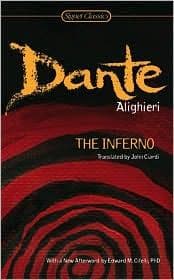
The Divine Comedy of Dante Alighieri: The InfernoDante Alighieri
ReligionJewish
The Divine Comedy of Dante Alighieri: The Inferno
Dante Alighieri
Epic poetry, Italian -- Translations into English; Hell; Italian poetry -- To 1400 -- Translations into English
street battle, in which he was worsted; and with his sons he had to take
refuge in the Palace of the People. There he stood a short siege against
the Ghibeline families and the angry mob; and in the same palace he was
kept prisoner for twenty days. Then, with his sons and grandsons, he was
carried in chains to the tower of the Gualandi, which stood where seven
ways met in the heart of Pisa. This was in July 1288. The imprisonment
lasted for months, and seems to have been thus prolonged with the view
of extorting a heavy ransom. It was only in the following March that the
Archbishop ordered his victims to be starved to death; for, being a
churchman, says one account, he would not shed blood. Not even a
confessor was allowed to Ugo and his sons. After the door of the tower
had been kept closed for eight days it was opened, and the corpses,
still fettered, were huddled into a tomb in the Franciscan church.--The
original authorities are far from being agreed as to the details of
Ugo's overthrow and death.--For the matter of this note I am chiefly
indebted to the careful epitome of the Pisan history of that time by
Philalethes in his note on this Canto (_Göttliche Comödie_).
FOOTNOTES:
[829] _The sinner_: Count Ugolino. See note at the end of the Canto.
[830] _Mingle speech, etc._: A comparison of these words with those of
Francesca (_Inf._ v. 124) will show the difference in moral tone between
the Second Circle of Inferno and the Ninth.
[831] _A Florentine_: So Farinata (_Inf._ x. 25) recognises Dante by his
Florentine speech. The words heard by Ugo are those at xxxii. 133.
[832] _The Archbishop Roger_: Ruggieri, of the Tuscan family of the
Ubaldini, to which the Cardinal of _Inf._ x. 120 also belonged. Towards
the end of his life he was summoned to Rome to give an account of his
evil deeds, and on his refusal to go was declared a rebel to the Church.
Ugolino was a traitor to his country; Roger, having entered into some
sort of alliance with Ugolino, was a traitor to him. This has led some
to suppose that while Ugolino is in Antenora he is so close to the edge
of it as to be able to reach the head of Roger, who, as a traitor to his
friend, is fixed in Ptolomæa. Against this view is the fact that they
are described as being in the same hole (xxxii. 125), and also that in
Ptolomæa the shades are set with head thrown back, and with only the
face appearing above the ice, while Ugo is described as biting his foe
at where the skull joins the nape. From line 91 it is clear that
Ptolomæa lay further on than where Roger is. Like Ugo he is therefore
here as a traitor to his country.
[833] _Were waste, etc._: For Dante knows it already, all Tuscany being
familiar with the story of Ugo's fate.
Public-domain text, read in full here on John Shaqi.
Reviews
Reviews
No reviews yet
Be the first to share your thoughts on this work.
Elsewhere in the archive
Join the Discussion
Join the discussion
Sign in to leave a comment or review.
Sign InorCreate an account