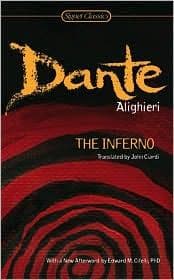
The Divine Comedy of Dante Alighieri: The InfernoDante Alighieri
ReligionJewish
The Divine Comedy of Dante Alighieri: The Inferno
Dante Alighieri
Epic poetry, Italian -- Translations into English; Hell; Italian poetry -- To 1400 -- Translations into English
[834] _Whose epithet of Famine_: It was called the Tower of Famine. Its
site is now built over. Buti, the old Pisan commentator of Dante, says
it was called the Mew because the eagles of the Republic were kept in it
at moulting-time. But this may have been an after-thought to give local
truth to Dante's verse, which it does at the expense of the poetry.
[835] _Many moons_: The imprisonment having already lasted for eight
months.
[836] _The height, etc._: Lucca is about twelve miles from Pisa, Mount
Giuliano rising between them.
[837] _Lanfranchi, etc._: In the dream, these, the chief Ghibeline
families of Pisa, are the huntsmen, Roger being master of the hunt, and
the populace the hounds. Ugo and his sons and grandsons are the wolf and
wolf-cubs. In Ugo's dream of himself as a wolf there may be an allusion
to his having engaged in the Guelf interest.
[838] _My sons_: According to Dante, taken literally, four of Ugo were
imprisoned with him. It would have hampered him to explain that two were
grandsons--Anselmuccio and Nino, called the Brigata at line 89,
grandsons by their mother of King Enzo, natural son of Frederick
II.--the sons being Gaddo and Uguccione, the latter Ugo's youngest son.
[839] _Each was fearful, etc._: All the sons had been troubled by dreams
of famine. Had their rations been already reduced?
[840] _The under gate, etc._: The word translated _made fast_
(_chiavare_) may signify either to nail up or to lock. The commentators
and chroniclers differ as to whether the door was locked, nailed, or
built up. I would suggest that the lower part of the tower was occupied
by a guard, and that the captives had not been used to hear the main
door locked. Now, when they hear the great key creaking in the lock,
they know that the tower is deserted.
[841] _The four faces, etc._: Despairing like his own, or possibly that,
wasted by famine, the faces of the young men had become liker than ever
to Ugo's own time-worn face.
[842] _Famine, etc._: This line, quite without reason, has been held to
mean that Ugo was driven by hunger to eat the flesh of his children. The
meaning is, that poignant though his grief was it did not shorten his
sufferings from famine.
[843] _Where the Si, etc._: Italy, _Si_ being the Italian for _Yes_.
In his _De Vulg. El._, i. 8, Dante distinguishes the Latin
languages--French, Italian, etc.--by their words of affirmation, and so
terms Italian the language of _Si_. But Tuscany may here be meant,
where, as a Tuscan commentator says, the _Si_ is more sweetly pronounced
than in any other part of Italy. In Canto xviii. 61 the Bolognese are
distinguished as the people who say _Sipa_. If Pisa be taken as being
specially the opprobrium of Tuscany the outburst against Genoa at the
close of the Canto gains in distinctness and force.
[844] _Gorgona and Capraia_: Islands not far from the mouth of the Arno.
Public-domain text, read in full here on John Shaqi.
Reviews
Reviews
No reviews yet
Be the first to share your thoughts on this work.
Elsewhere in the archive
Join the Discussion
Join the discussion
Sign in to leave a comment or review.
Sign InorCreate an account