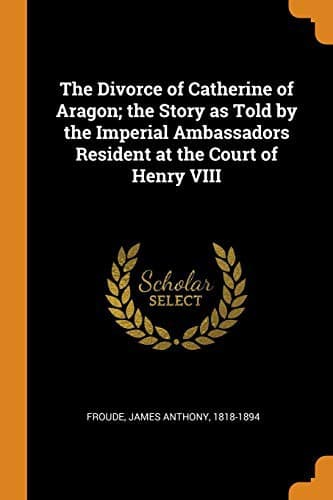
The Divorce of Catherine of Aragon: The Story as Told by the Imperial Ambassadors Resident at the Court of Henry VIII — John Shaqi
The Divorce of Catherine of Aragon: The Story as Told by the Imperial Ambassadors Resident at the Court of Henry VIIIFroude, James Anthony
History
The Divorce of Catherine of Aragon: The Story as Told by the Imperial Ambassadors Resident at the Court of Henry VIII
Froude, James Anthony
Catharine, of Aragon, Queen, consort of Henry VIII, King of England, 1485-1536 -- Divorce; Divorce -- Great Britain -- History -- 16th century; Great Britain -- History -- Henry VIII, 1509-1547 -- Biography; Great Britain -- Kings and rulers -- Biography; Henry VIII, King of England, 1491-1547 -- Di
Exeter, who was Edward IV.'s grandson; the Countess of Salisbury, daughter
of Edward's brother the Duke of Clarence, and sister of the murdered Earl
of Warwick; and Henry's life was the only obstacle between the collision
of these opposing pretensions. James, it was quite certain, would not be
allowed to succeed without a struggle. National rivalry forbade it. Yet it
was no less certain that he would try, and would probably be backed by
France. There was but one escape from convulsions which might easily be
the ruin of the realm. The King was in the flower of his age, and might
naturally look for a Prince of Wales to come after him if he was married
to a woman capable of bearing one. It is neither unnatural nor, under the
circumstances, a matter to be censured if he and others began to reflect
upon the peculiar character of his connection with Catherine of Aragon. It
is not sufficiently remembered that the marriage of a widow with her
husband's brother was then, as it is now, forbidden by the laws of all
civilised countries. Such a marriage at the present day would be held
_ipso facto_ invalid and not a marriage at all. An irregular power was
then held to rest with the successors of St. Peter to dispense, under
certain conditions, with the inhibitory rules. The popes are now
understood to have never rightly possessed such an authority, and
therefore, according to modern law and sentiment, Henry and Catherine
never were husband and wife at all. At the time it was uncertain whether
the dispensing power extended so far as to sanction such a union, and when
the discussion rose upon it the Roman canonists were themselves divided.
Those who maintained the widest view of the papal faculty yet agreed that
such a dispensation could only be granted for urgent cause, such as to
prevent foreign wars or internal seditions, and no such cause was alleged
to have existed when Ferdinand and Henry VII. arranged the marriage
between their children. The dispensation had been granted by Pope Julius
with reluctance, had been acted upon after considerable hesitation, and
was of doubtful validity, since the necessary conditions were absent. The
marriages of kings were determined with little reference to the personal
affection of the parties. Between Henry and Catherine there was probably
as much and as little personal attachment as there usually is in such
cases. He respected and perhaps admired her character; but she was not
beautiful, she was not attractive, while she was as proud and intractable
as her mother Isabella. Their union had been settled by the two fathers to
cement the alliance between England and Spain. Such connections rest on a
different foundation from those which are voluntarily entered into between
private persons. What is made up for political reasons may pardonably be
dissolved when other reasons of a similar kind require it; and when it
became clear that Catherine could never bear another child, that the
Reviews
Reviews
No reviews yet
Be the first to share your thoughts on this work.
Join the Discussion
Join the discussion
Sign in to leave a comment or review.
Sign InorCreate an account