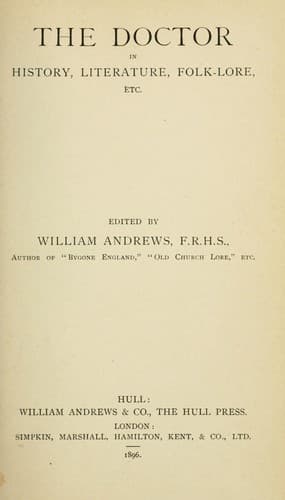
The Doctor in History, Literature, Folk-Lore, Etc.
History
The Doctor in History, Literature, Folk-Lore, Etc.
Literature and medicine; Physicians; Physicians in literature
thousand taels of silver are given for a pound's weight of the precious
root. It will be seen, therefore, from such facts as these that a Galen in
China would have a vast revolution to undertake, and that a thousand
Galens at least would be required to overcome the prejudices and uproot
the superstitions of the race. The great value which the Chinese attach to
the bones, horns, tusks, and eyes of animals may be judged from various
tonics and remedies which are in great request among all classes. A dose
of tigers' bones inspires courage; an elephant's eye burnt to powder and
mixed with human milk is a sovereign remedy for inflammation of the eye;
pulverised elephants' bones cure indigestion; a preparation of elephants'
ivory is the recognised cure for diabetes; and the same animal's teeth may
be used for epilepsy. But if the patient cannot eat rice his case is
abandoned as hopeless, and not even the physician who deals most
extensively in magic pills, ointments, and decoctions will attempt to save
the obstinate person's life.
The medicine-men of the Eskimos were called angekoks, and enjoyed the
unlimited confidence of the people. They were said to have equal power
over heaven and earth, this world and the next. This made them useful as
friends and dangerous as enemies. The Eskimo, therefore, set out upon no
enterprise without consulting the angekoks, who granted blessings,
exorcised demons, and gave charms against disease. These medicine-men have
a profound belief in themselves, and though they resort to jugglery and
ventriloquism to deceive their visitors, they appear to have no idea that
they are perpetrating an imposture. Their particular powers, they think,
are derived from more than human sources. Dr. Nansen, in his "Eskimo
Life," points out that it has always been to the interests of the
medicine-men and the priests to sustain and mature superstitions or
religious ideas. "They must therefore themselves appear to believe in
them; they may even discover new precepts of divinity to their own
advantage, and thereby increase both their power and their revenues." The
Greenlanders believe that the angekoks work with the help of ministering
spirits, called _tornat_, who are often none other than the souls of dead
persons, especially of grandfathers; but not infrequently the _tornat_ are
supposed to be the souls of departed animals, or of fairies. The angekok
is assumed to have several of these councillors always at hand. They
render help in the time of danger, and may even act as avengers or
destroyers. In the latter case they show themselves as ghosts, and so
frighten to death the persons against whom vengeance is directed.
Therefore, as Dr. Nansen reports, the angekoks are the wisest and also the
craftiest of all Eskimos. They assert that they have the power of
conversing with spirits, of travelling in the under-world, of conjuring
up powerful spirits, and of obtaining revelations. "They influence and
Public-domain text, read in full here on John Shaqi.
Reviews
Reviews
No reviews yet
Be the first to share your thoughts on this work.
Join the Discussion
Join the discussion
Sign in to leave a comment or review.
Sign InorCreate an account