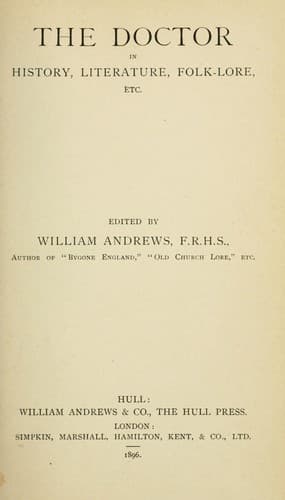
The Doctor in History, Literature, Folk-Lore, Etc.
History
The Doctor in History, Literature, Folk-Lore, Etc.
Literature and medicine; Physicians; Physicians in literature
work upon their countrymen principally through their mystic exorcisms and
_seances_, which occur as a rule in the winter, when they are living in
houses. The lamps are extinguished, and skins hung before the windows. The
angekok himself sits upon the floor. By dint of making a horrible noise so
that the whole house shakes, changing his voice, bellowing and shrieking,
ventriloquising, groaning, moaning, and whining, beating on drums,
bursting forth into diabolical shrieks of laughter and all sorts of other
tricks, he persuades his companions that he is visited by the various
spirits he personates, and that it is they who make the disturbance." They
cure diseases by reciting charms, and "give men a new soul." He demands
large fees, not for himself, he explains, but for the spirits whose agent
he is. Apparently these spirits have similar ideas to the London
consulting physician.
Mr. Theodore Bent, in his "Ruined Cities of Mashonaland," gives a specimen
of the credulity excited by the medicine-men. The explorer desired to
interview a chief, Mtoko by name, but permission was refused. The reason,
he afterwards ascertained, was that the chief's father had died shortly
after another white man's visit, and the common belief was that he had
been bewitched. The chief thought that the "white lady" who ruled over the
nation to which Mr. Bent belonged had sent him purposely to cast a glamour
over him. It may be remembered that the ill-fated Lobengula refused to
have his portrait taken because he believed that by means of the image of
himself he could be magically infected with a dread disease. This idea of
substitution, which has already been referred to, is akin to that of the
belief in witchcraft during the middle ages--namely, that the witches
could, by sticking pins into the wax image of a person, bring upon that
person agonising maladies. The dreadful results of such beliefs among
savage tribes is told by the two hospital nurses who a year or so ago
produced a lively book, "Adventures in Mashonaland." One morning a native
entered their camp, bringing a tale of horror. A chief called Maronka,
whose kraal was about forty miles away, had boiled his family alive. He
had been convinced by the native doctors that after death the souls of the
chiefs passed into the bodies of lions. His medicine-men had "smelt out"
his own family as witches, and boiling alive was the requisite punishment.
Mr. Rider Haggard has told many such stories as this in his books on South
Africa. The Zulu doctors were in the habit, not only of "smelling out"
witches and evil spirits, but of sprinkling the soldiers with medicine, in
order to "put a great heart into them," and ensure their victory in
battle.
Public-domain text, read in full here on John Shaqi.
Reviews
Reviews
No reviews yet
Be the first to share your thoughts on this work.
Join the Discussion
Join the discussion
Sign in to leave a comment or review.
Sign InorCreate an account