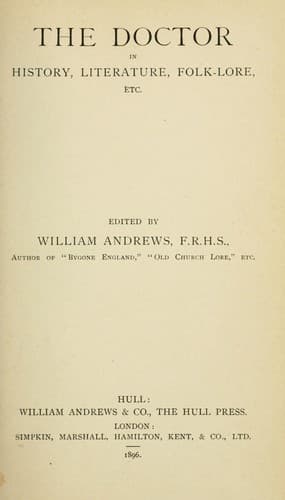
The Doctor in History, Literature, Folk-Lore, Etc.
History
The Doctor in History, Literature, Folk-Lore, Etc.
Literature and medicine; Physicians; Physicians in literature
Mr. Austine Waddell, in his exhaustive work on the Buddhism of Tibet,
tells us that a very popular form of Buddha is as "the supreme physician"
or Buddhist AEsculapius, the idea of whom is derived from an ancient legend
of the "medicine-king" who dispensed spiritual medicine. The images of
this Buddha are worshipped as fetishes, and they cure by sympathetic
magic. The supplicant, after bowing and praying, rubs his finger over the
eye, knee, or particular part of the image corresponding to the affected
part on his own body, and then applies the finger carrying this hallowed
touch to the afflicted spot. Mr. Waddell says that this constant friction
is rather detrimental to the features of the god; whether it is beneficial
to the man's body is of course largely a matter of faith and
circumstances. As might be expected, talismans to ward off evils from
malignant planets and demons, whence come all diseases, are in great
request. The eating of the paper on which a charm has been written is
considered by the Tibetan to be the easiest and most certain method of
curing a malady, and the spells which the Lamas use in this way are called
"za-yig," or edible letters. A still more mystical way of applying these
remedies, according to Mr. Waddell, is by the washings of the reflection
of the writing in a mirror, a habit common in other quarters of the globe.
In Gambia, for instance, this treatment is relied upon by the natives. A
doctor is called in, he examines the patient, and then sits down at the
bedside and writes in Arabic characters on a slate some sentences from the
Koran. The slate is then washed, and the dirty infusion is drunk by the
patient. In Tibet, Chinese ink is smeared on wood, and every twenty-nine
days the inscription reflected in a mirror. The face of the mirror during
the reflection is washed with beer, and the drainings are collected in a
cup for the patient's use. This is a special cure for the evil eye. The
medicine-men of Tibet can also supply charms against bullets and weapons,
charms for the clawing of animals, charms to ward off cholera, and even
charms to prevent domestic broils. This is surely evidence of high
civilisation.
It would be hopeless to endeavour to exhaust this subject. Only a few
selected instances can be given to illustrate how large a part magic has
played, and still plays, in the healing art. Medicine is by no means freed
of its superstitions yet, and the success of quack advertisements of the
day abundantly proves that the civilised public is still prone to believe
that universal remedies are obtainable, and that miracles can be wrought.
Public-domain text, read in full here on John Shaqi.
Reviews
Reviews
No reviews yet
Be the first to share your thoughts on this work.
Join the Discussion
Join the discussion
Sign in to leave a comment or review.
Sign InorCreate an account