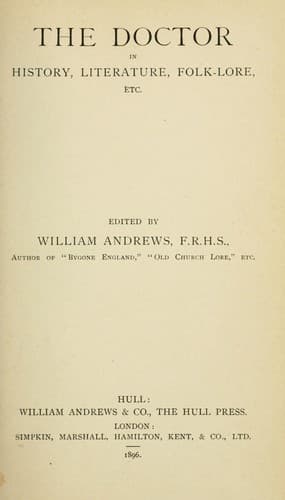
The Doctor in History, Literature, Folk-Lore, Etc.
History
The Doctor in History, Literature, Folk-Lore, Etc.
Literature and medicine; Physicians; Physicians in literature
Customs like these gave Charles Dickens his opportunity of writing two of
his most scathing satires "The Noble Savage" and "The Medicine Man of
Civilisation." He refused to subscribe to the popular and amiable
sentiment that the African barbarian was an interesting survival, or that
the Ojibbeway Indian was picturesque. After a severe indictment of them,
Dickens instanced their customs in medicine as a proof of their
irremediable depravity. "When the noble savage finds himself a little
unwell," he wrote, "and mentions the circumstance to his friends, it is
immediately perceived that he is under the influence of witchcraft. A
learned personage, called an Imyanger, or Witch Doctor, is sent for to
Nooker the Umtargartie, or smell out the witch. The male inhabitants of
the kraal being seated on the ground, the learned doctor, got up like a
grizzly bear, appears and administers a dance of the most terrific nature,
during the exhibition of which remedy he incessantly gnashes his teeth,
and howls,--'I am the original physician to Nooker the Umtargartie. Yow,
yow, yow! No connection with any other establishment. Till, till, till!
All other Umtargarties are feigned Umtargarties, Boroo, Boroo! but I
perceive here a genuine and real Umtargartie, Hoosh, Hoosh, Hoosh! in
whose blood, I, the original Imyanger and Nookerer, will wash these bear's
claws of mine!' All this time the learned physician is looking out among
the attentive faces for some unfortunate man who owes him a cow, or who
has given him any small offence, or against whom, without offence, he has
conceived a spite. Him he never fails to Nooker as the Umtargartie, and he
is instantly killed." This is no burlesque, and I have given the record in
Dickens's inimitable language because it most vividly sets before us the
custom of the medicine-men of barbarous races. But the medicine-men of
Longfellow's description, the men who came to appease and console
Hiawatha, who
"Walked in silent, grave procession,
Bearing each a pouch of healing,
Skin of beaver, lynx, or otter,
Filled with magic roots and simples,
Filled with very potent medicines,"
--these may be accepted as the milder type of magicians who, among a
primitive people, claimed not only to be able to heal the living, but to
restore the dead.
Public-domain text, read in full here on John Shaqi.
Reviews
Reviews
No reviews yet
Be the first to share your thoughts on this work.
Join the Discussion
Join the discussion
Sign in to leave a comment or review.
Sign InorCreate an account