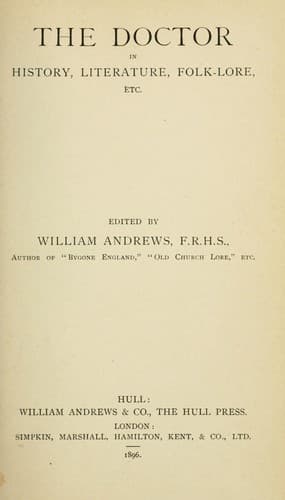
The Doctor in History, Literature, Folk-Lore, Etc.
History
The Doctor in History, Literature, Folk-Lore, Etc.
Literature and medicine; Physicians; Physicians in literature
In the nave of Westminster Abbey on a memorial of polished granite is this
inscription--"Beneath are deposited the remains of JOHN HUNTER, born at
Long Calderwood, Lanarkshire, N.B., on February 14th, 1728; died in London
on October 10th, 1793. His remains were removed from the Church of St.
Martins-in-the-Fields to this Abbey on March 28th, 1858. The Royal College
of Surgeons of England have placed this table over the grave of Hunter to
record their admiration of his genius as a gifted interpreter of the
Divine power and wisdom that works in the laws of organic life, and their
grateful veneration for his services to mankind as the Father of
scientific surgery. 'O Lord, how manifold are Thy works; in wisdom hast
Thou made them all.'"
Such honours are not paid to the remains of men of common stamp. And of no
common stamp was the sandy-headed youth who, having spent ten years of his
life learning cabinet making, resolved on striking out a better career for
himself; and in his twentieth year took horse and journeyed to London to
place himself under his elder brother, WILLIAM HUNTER, then rising into
note as a medical practitioner and a teacher of anatomy. In October, 1748,
he entered his brother's dissecting room, and whether the fitting of
joints in cabinetware had been of initiatory service, or he had had access
to the books of his medical relations in Glasgow, or that as a boy upon
his father's farm, observation of the domestic animals and of the wild
inhabitants of wood and fell, had roused the desire to master the secrets
of animated nature, sure it is that William speedily foretold a successful
future for his new pupil as an anatomist.
At all events he used his interest to place his promising brother under
the eminent surgeon of Chelsea Hospital, and later under another at St.
Bartholomew's. Then, shocked by the rough speech and manners of his
countrified brother, and his need of education, the classical elder packed
him off to college to pick up a little refinement along with Latin and
Greek.
In vain. Irrepressible and hot-tempered John could not sit down quietly to
study dead languages. Back he came from Oxford in haste, to study dead
bodies in his brother's dissecting room, and serve as demonstrator to his
course of lectures, simultaneously with his study of living bodies at St.
George's Hospital, where in a comparatively short time he became
house-surgeon.
His appointment as staff-surgeon to our troops on foreign service marked
the six intervening years before he settled down to practise in London. He
had laboured ten years on human anatomy, and had dissected a number of the
lower animals, laying the foundation of his collection of comparative
anatomy. Even while on foreign service he had amused himself with studying
the digestive faculties of snakes and lizards when in a torpid state, and
many were the contributions he sent home to his brother's museum.
Public-domain text, read in full here on John Shaqi.
Reviews
Reviews
No reviews yet
Be the first to share your thoughts on this work.
Elsewhere in the archive
Join the Discussion
Join the discussion
Sign in to leave a comment or review.
Sign InorCreate an account