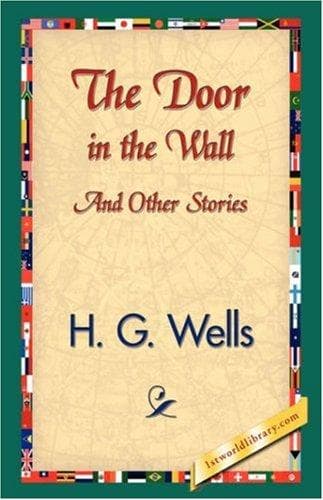
The Door in the Wall, and Other StoriesWells, H. G. (Herbert George)
Science
The Door in the Wall, and Other Stories
Wells, H. G. (Herbert George)
Fantasy fiction, English; Science fiction, English; Short stories
“I suppose my second experience with the green door marks the world of
difference there is between the busy life of a schoolboy and the
infinite leisure of a child. Anyhow, this second time I didn’t for a
moment think of going in straight away. You see . . . For one thing my
mind was full of the idea of getting to school in time—set on not
breaking my record for punctuality. I must surely have felt _some_
little desire at least to try the door—yes, I must have felt that . . .
. . But I seem to remember the attraction of the door mainly as another
obstacle to my overmastering determination to get to school. I was
immediately interested by this discovery I had made, of course—I went
on with my mind full of it—but I went on. It didn’t check me. I ran
past tugging out my watch, found I had ten minutes still to spare, and
then I was going downhill into familiar surroundings. I got to school,
breathless, it is true, and wet with perspiration, but in time. I can
remember hanging up my coat and hat . . . Went right by it and left it
behind me. Odd, eh?”
He looked at me thoughtfully. “Of course, I didn’t know then that it
wouldn’t always be there. School boys have limited imaginations. I
suppose I thought it was an awfully jolly thing to have it there, to
know my way back to it, but there was the school tugging at me. I
expect I was a good deal distraught and inattentive that morning,
recalling what I could of the beautiful strange people I should
presently see again. Oddly enough I had no doubt in my mind that they
would be glad to see me . . . Yes, I must have thought of the garden
that morning just as a jolly sort of place to which one might resort in
the interludes of a strenuous scholastic career.
“I didn’t go that day at all. The next day was a half holiday, and that
may have weighed with me. Perhaps, too, my state of inattention brought
down impositions upon me and docked the margin of time necessary for
the detour. I don’t know. What I do know is that in the meantime the
enchanted garden was so much upon my mind that I could not keep it to
myself.
“I told—What was his name?—a ferrety-looking youngster we used to call
Squiff.”
“Young Hopkins,” said I.
“Hopkins it was. I did not like telling him, I had a feeling that in
some way it was against the rules to tell him, but I did. He was
walking part of the way home with me; he was talkative, and if we had
not talked about the enchanted garden we should have talked of
something else, and it was intolerable to me to think about any other
subject. So I blabbed.
“Well, he told my secret. The next day in the play interval I found
myself surrounded by half a dozen bigger boys, half teasing and wholly
curious to hear more of the enchanted garden. There was that big
Fawcett—you remember him?—and Carnaby and Morley Reynolds. You weren’t
there by any chance? No, I think I should have remembered if you were .
. . . .
Public-domain text, read in full here on John Shaqi.
Reviews
Reviews
No reviews yet
Be the first to share your thoughts on this work.
Join the Discussion
Join the discussion
Sign in to leave a comment or review.
Sign InorCreate an account