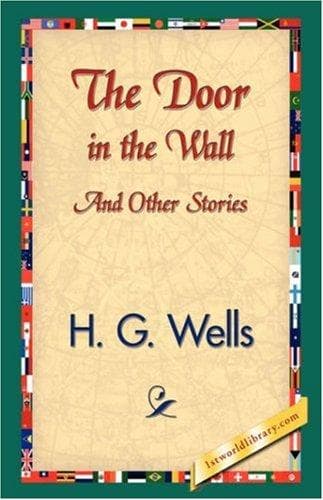
The Door in the Wall, and Other StoriesWells, H. G. (Herbert George)
Science
The Door in the Wall, and Other Stories
Wells, H. G. (Herbert George)
Fantasy fiction, English; Science fiction, English; Short stories
“A boy is a creature of odd feelings. I was, I really believe, in spite
of my secret self-disgust, a little flattered to have the attention of
these big fellows. I remember particularly a moment of pleasure caused
by the praise of Crawshaw—you remember Crawshaw major, the son of
Crawshaw the composer?—who said it was the best lie he had ever heard.
But at the same time there was a really painful undertow of shame at
telling what I felt was indeed a sacred secret. That beast Fawcett made
a joke about the girl in green—.”
Wallace’s voice sank with the keen memory of that shame. “I pretended
not to hear,” he said. “Well, then Carnaby suddenly called me a young
liar and disputed with me when I said the thing was true. I said I knew
where to find the green door, could lead them all there in ten minutes.
Carnaby became outrageously virtuous, and said I’d have to—and bear out
my words or suffer. Did you ever have Carnaby twist your arm? Then
perhaps you’ll understand how it went with me. I swore my story was
true. There was nobody in the school then to save a chap from Carnaby
though Crawshaw put in a word or so. Carnaby had got his game. I grew
excited and red-eared, and a little frightened, I behaved altogether
like a silly little chap, and the outcome of it all was that instead of
starting alone for my enchanted garden, I led the way presently—cheeks
flushed, ears hot, eyes smarting, and my soul one burning misery and
shame—for a party of six mocking, curious and threatening
school-fellows.
“We never found the white wall and the green door . . .”
“You mean?—”
“I mean I couldn’t find it. I would have found it if I could.
“And afterwards when I could go alone I couldn’t find it. I never found
it. I seem now to have been always looking for it through my school-boy
days, but I’ve never come upon it again.”
“Did the fellows—make it disagreeable?”
“Beastly . . . . . Carnaby held a council over me for wanton lying. I
remember how I sneaked home and upstairs to hide the marks of my
blubbering. But when I cried myself to sleep at last it wasn’t for
Carnaby, but for the garden, for the beautiful afternoon I had hoped
for, for the sweet friendly women and the waiting playfellows and the
game I had hoped to learn again, that beautiful forgotten game . . . .
.
“I believed firmly that if I had not told— . . . . . I had bad times
after that—crying at night and wool-gathering by day. For two terms I
slackened and had bad reports. Do you remember? Of course you would! It
was _you_—your beating me in mathematics that brought me back to the
grind again.”
III
For a time my friend stared silently into the red heart of the fire.
Then he said: “I never saw it again until I was seventeen.
Public-domain text, read in full here on John Shaqi.
Reviews
Reviews
No reviews yet
Be the first to share your thoughts on this work.
Join the Discussion
Join the discussion
Sign in to leave a comment or review.
Sign InorCreate an account