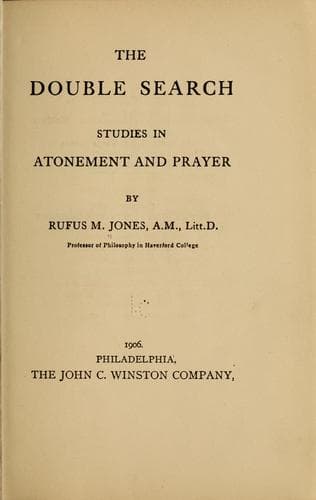
The Double Search: Studies in Atonement and PrayerJones, Rufus M. (Rufus Matthew)
Religion
The Double Search: Studies in Atonement and Prayer
Jones, Rufus M. (Rufus Matthew)
Atonement; Prayer -- Christianity
What does the little fellow do? He instinctively feels the need of some
sacrifice. He must soften his father by giving him something. He breaks
open his bank and brings his father his pennies, or he brings in his
hand the most precious plaything he owns, and acts out his troubled
inward condition. He wants the gap closed and he feels that it will
cost something to get it closed.[7] That is human nature. That feeling
is deep-rooted in man wherever he is found. He is conscious that sin
separates and he feels that something costly and precious is required
to close the chasm. Sacrifice is one of the deepest and most permanent
facts of the budding spiritual life. Its origin is far back in history.
The tattered papyrus, the fragment of baked clay, the pictorial
inscription of the most primitive sort, all bear witness to this
immemorial custom. It is as old as smiling or weeping, as hard to trace
to a beginning as loving or hating. It is bound up with man’s sense of
guilt, and was born when conscience was born. Dark and fantastic are
many of the chapters of the long story of man’s efforts to square the
account. Priests have seized upon this instinctive tendency and have
twisted it into abnormal shapes, but they did not create it--it is
elemental. The idea of an angry God who must be appeased and satisfied
was born with this consciousness of guilt, it is a natural product of
the shadow of human sin.[8] The historic theories of the atonement,
inherited from the Roman church, were all formulated under the sway of
this idea.
The two fundamental aspects of sin, then, are (1) its inward moral
effect upon the soul, its enslaving power over the sinner, and (2)
its tendency to open a chasm between God and man, to make God appear
full of wrath. How does Christ meet this human situation? What is the
heart of the Gospel? First of all, Christ reverses the entire pagan
attitude. He reveals God as a Father whose very inherent nature is
love and tenderness and forgiveness. In place of a sovereign demanding
justice, He shows an infinite Lover. We must either give up the parable
of the Prodigal Son, or accept this view of God. But this parable fits
the entire Gospel. John was only uttering what Jesus Christ taught by
every act of His life and what He exhibited supremely on His cross,
when He said “God is Love.” To surrender this truth, and to start with
the assumption of a God who must be appeased, or reconciled or changed
in attitude is to surrender the heart of the Gospel, and to weave the
shining threads of our message of salvation in with the black threads
of a pagan warp. He who came to show us the Father, has unmistakably
showed Him full of love, not only for the saint, for the actual son;
but also for the sinner, the potential son. Either God _is_ Love, or we
must conclude that Christ has not revealed Him as He is.
Public-domain text, read in full here on John Shaqi.
Reviews
Reviews
No reviews yet
Be the first to share your thoughts on this work.
Join the Discussion
Join the discussion
Sign in to leave a comment or review.
Sign InorCreate an account