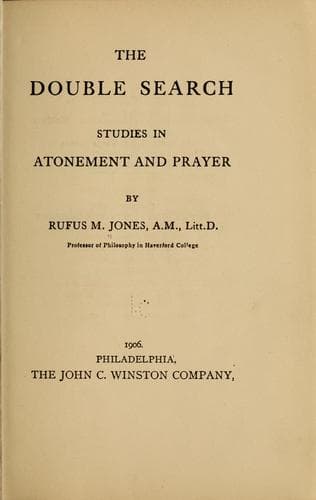
The Double Search: Studies in Atonement and Prayer — John Shaqi
The Double Search: Studies in Atonement and PrayerJones, Rufus M. (Rufus Matthew)
Religion
The Double Search: Studies in Atonement and Prayer
Jones, Rufus M. (Rufus Matthew)
Atonement; Prayer -- Christianity
But the great difficulty is that so many fail to see what Divine Love
and human sin involve when they come together. It has superficially
been assumed that if God is a loving Father He will lightly overlook
sin and cannot be hard upon the sinner. They catch at a soft view of
sin and patch up a rose water theory of its cure. This soft view has
appealed to those who like an easy religion, and it has often driven
the evangelical Christian to an opposite extreme, which finds no
support in the Gospel. To arrive at a deeper view we must go back to
Christ and go down into the deeps of love as we know it in actual human
life.
True love is never weak and thin, and unconcerned about the character
of the beloved. The father does not “lay aside” his love when he
punishes his erring boy, and keeps him impressed with the reality of
moral distinctions. It is the father’s intense love which wields
the rod. All true corrections and chastisements flow out of love.
Even Dante knew this, when he wrote on the door of Hell, “Love was my
maker.” It is an ignorant and mushy love that cannot rise above kisses
and sugar plums, and it is extremely superficial to set up a schism
between love and justice.
But that is not all. Love always involves vicarious suffering. Love
is an organic principle. It carries with it the necessity of sharing
life with other persons, and in a world of imperfect persons, it means
not only sharing gains and triumphs, it means, too, sharing losses and
defeats. No man can sin in a sin-tight compartment. Suffer for his
own sin the sinner assuredly will. But he does not stop there. Many
innocent persons will suffer for it, too. This is one of the tragic
aspects of life which has baffled many a lone sufferer like Job. Those
who are nearest and closest to the sufferer will suffer most, but his
sin has endless possibilities of causing suffering upon persons far
remote in time and space. That ancient figure of the ripples from the
little pebble, which sends rings to the farthest shores of the sea,
is not overdrawn. Not one of us can estimate the havoc of his sin, or
forecast the trail of suffering which it will leave behind it. So long
as life remains organic there will be vicarious suffering.
But that is only one side of life. Holiness also involves a like
suffering. There are no holiness-tight compartments. No man can be holy
unto himself. Just as far as he has any rag of holiness he must share
it--he must feel himself a debtor to others who lack--he must take up
the task of making others holy. _That costs something._
Public-domain text, read in full here on John Shaqi.
Reviews
Reviews
No reviews yet
Be the first to share your thoughts on this work.
Join the Discussion
Join the discussion
Sign in to leave a comment or review.
Sign InorCreate an account