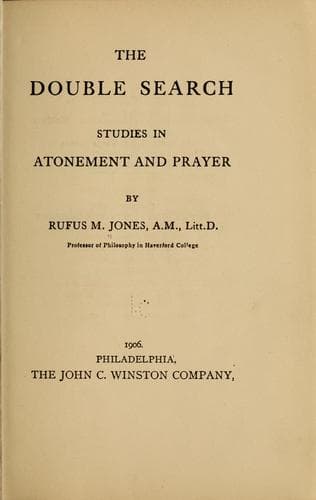
The Double Search: Studies in Atonement and Prayer — John Shaqi
The Double Search: Studies in Atonement and PrayerJones, Rufus M. (Rufus Matthew)
Religion
The Double Search: Studies in Atonement and Prayer
Jones, Rufus M. (Rufus Matthew)
Atonement; Prayer -- Christianity
You cannot command or compel people into holiness, you cannot increase
their spiritual stature one cubit by any kind of force or compulsion.
You can do it only by sharing your life with them, by making them feel
your goodness, by your love and sacrifice for them. When a martyr
dies for some truth, men suddenly discover for the first time how
much it is worth and they eagerly pursue it over all obstacles. In
spiritual things we always make our appeal to the _cost_ of the truth
or the principle. Think of the blood which has been shed for freedom
of conscience! Remember what a price has been paid in blood for the
principle of democracy! Thus we speak of all the privileges of life.
They are ours because somebody has felt that they were worth the cost,
because somebody has died that we might freely have them. It is the
tragedy of human life that we must suffer through the sin of others,
and we must suffer also if we would carry goodness or holiness into
other lives. Every bit of goodness which ever prevails anywhere in this
world has cost somebody something.
This principle of vicarious suffering is no late arrival; it appears
at every scale of life, heightening as we go up--becoming less blind
and more voluntary. It was a central truth of Christ’s revelation that
this principle does not stop with man; it goes on up to the top of the
spiritual scale. It finds its complete and final expression in God
Himself. God’s life and our lives are bound together, as a vine with
branches, as a body with members. _So corporate_ are we that no one
can give a cup of cold water to the least person in the world without
giving it to Him! But He is perfect and we are imperfect, He is holy
and we sin. If the wayward boy, who wastes his life, pains the heart
of his mother whose life is wrapped up in him, can we fling our lives
away and not make our Heavenly Father suffer? The cross is the answer.
He has undertaken to make Sons of God out of such creatures as we are,
to take us out of the pit and the miry clay, to put spiritual songs in
our mouths and write His own name on our foreheads, will that cost Him
nothing? Again, the cross is the answer.
Here we discover--it is the main miracle of the Gospel--that the
original movement to bridge the chasm comes from the Divine side.
What man hoped to do, but could not, with his bleating lamb and timid
dove, God Himself has done. He has reached across the chasm, taking
on Himself the sacrifice and cost, to show the sinner that the only
obstruction to peace and reconciliation is in the sinner himself. “This
is love, not that we loved Him, but that He loved us,” and this is
sacrifice, not that we give our bulls and goats to please Him, but that
He gives Himself to draw us.
Browning puts it all in a line:
“Thou needs must love me who have died for thee.”
Public-domain text, read in full here on John Shaqi.
Reviews
Reviews
No reviews yet
Be the first to share your thoughts on this work.
Join the Discussion
Join the discussion
Sign in to leave a comment or review.
Sign InorCreate an account