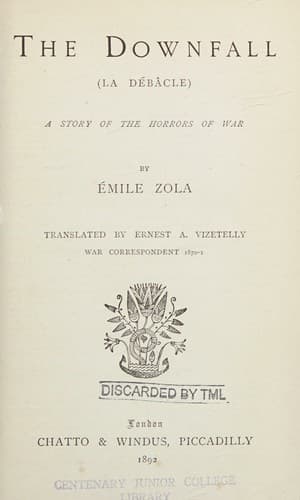
The Downfall (La Débâcle): A Story of the Horrors of WarZola, Émile
General
The Downfall (La Débâcle): A Story of the Horrors of War
Zola, Émile
Franco-Prussian War, 1870-1871 -- Fiction
Meanwhile, Maurice Levasseur had begun to chat again with his
brother-in-law Weiss, and his cousin Honoré Fouchard, the
quartermaster. The tattoo party, coming from afar off with its numbers
gradually strengthened, passed near them, drumming and trumpeting
in the melancholy twilight peacefulness; and yet they did not seem
to hear it even. Grandson of a hero of the First Napoleon's armies,
Maurice was born at Le Chêne Populeux, in the Argonne. His father,
being turned away from the paths of glory, had sunk down to a meagre
tax-collectorship; and his mother, a peasant woman, had expired in
bringing him and his twin sister, Henriette, into the world. If Maurice
had enlisted in the army, it was because of grave offences, the outcome
of a course of dissipation in which his weak, excitable nature had
embarked at the time when he had repaired to Paris to read for the
bar, and when his relatives had pinched and stinted themselves to
make a gentleman of him. But he had squandered their money in gaming,
on women, and on the thousand and one follies of the all-devouring
city, and his conduct had hastened his father's death. His sister,
after parting with her all to pay his debts, had been lucky enough to
secure a husband, that honest fellow Weiss, an Alsatian of Mulhausen,
who had long been an accountant at the refinery of Le Chêne Populeux,
and was now an overseer in the employ of M. Delaherche, owner of one
of the principal cloth-weaving establishments of Sedan. Maurice, who
with his nervous nature was seized as promptly with hope as with
despair, who was both generous and enthusiastic, but utterly devoid of
stability--the slave indeed of each shifting, passing breeze--imagined
that he was now quite cured of his follies. Fair and short, with an
unusually large forehead, a small nose and chin, and generally refined
features, he had grey, caressing eyes, in which there gleamed at times
a spark of madness.
Weiss had hastened to Mulhausen on the eve of hostilities, having
suddenly become desirous of settling some family affair; and if he had
availed himself of Colonel de Vineuil's kindness, in order to shake
hands with his brother-in-law, Maurice, it was because the colonel
happened to be the uncle of young Madame Delaherche, a pretty widow,
whom the cloth merchant of Sedan had married the year before, and whom
both Maurice and Henriette had known when she was a child, her parents
then being neighbours of their own. Besides the colonel, Maurice had
come across another of Madame Delaherche's connections in the person
of Captain Beaudoin, who commanded his company, and who had been this
lady's most intimate friend, it was insinuated, at the time when she
was Madame Maginot of Mézières, wife of M. Maginot, inspector of the
State forest.
'Mind you kiss Henriette for me,' said Maurice, again and again--he
was, indeed, passionately fond of his sister--'tell her she will have
every reason to be pleased, and that I want to make her proud of me.'
Public-domain text, read in full here on John Shaqi.
Reviews
Reviews
No reviews yet
Be the first to share your thoughts on this work.
Join the Discussion
Join the discussion
Sign in to leave a comment or review.
Sign InorCreate an account