The Downfall (La Débâcle): A Story of the Horrors of War — John Shaqi
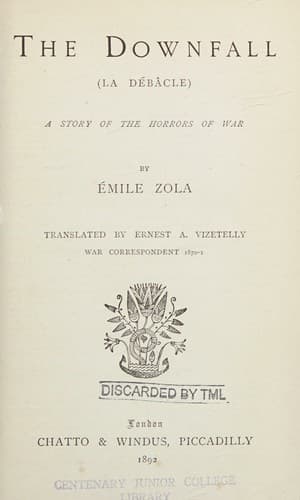
The Downfall (La Débâcle): A Story of the Horrors of WarZola, Émile
General
The Downfall (La Débâcle): A Story of the Horrors of War
Zola, Émile
Franco-Prussian War, 1870-1871 -- Fiction
Tears filled his eyes as he thought of his foolish conduct in Paris;
but his brother-in-law, touched in his turn, changed the conversation
by saying to Honoré Fouchard, the artilleryman: 'The first time I pass
by Remilly I shall run up and tell uncle Fouchard that I saw you and
found you well.'
Uncle Fouchard, a peasant with a little land of his own, who plied
the calling of itinerant village butcher, was a brother of Maurice's
mother. He lived at Remilly, right at the top of the hill, at four
miles or so from Sedan.
'All right,' said Honoré, quietly; 'the old man doesn't care a rap
about me, but, if it pleases you, you can go to see him.'
Just at that moment there was a stir in front of the farmhouse, and
they saw the prowler--the man accused of being a Prussian spy--come
out, accompanied by an officer. He had no doubt produced some papers,
related some plausible tale or other, for he was no longer under
arrest--the officer was simply turning him out of the camp. At that
distance, in the impending darkness, one could only vaguely distinguish
his huge, square-built figure and tawny head. Maurice, however,
impetuously exclaimed: 'Look there, Honoré. Isn't that fellow like the
Prussian--you know the man I mean--Goliath?'
The quartermaster started on hearing this name, and fixed his ardent
eyes upon the supposed spy. This mention of Goliath Steinberg, the
slaughterman, the rascal who had made bad blood between himself and
his father, who had robbed him of his sweetheart Silvine, had revived
all the horrible story--the filthy abomination that still caused him
so much suffering--and he felt a sudden impulse to run after the man
and strangle him. But the spy, if such he was, had already passed
beyond the camp lines, and, walking rapidly away, soon vanished in the
darkness of the night.
'Oh! Goliath,' muttered Honoré; 'it isn't possible. He must be over
there with the others. Ah! if ever I meet him----'
And with a threatening gesture he pointed to the darkening horizon, the
violet-tinted eastern sky which to him meant Prussia.
They all relapsed into silence, and the tattoo was again heard afar
off, at the other end of the camp. 'Blazes!' resumed Honoré, 'I shall
get into trouble if I'm not back for the roll call. Good night.
Good-bye to all!' Then having once more pressed Weiss's hands he
hastily strode away towards the hillock where the reserve artillery was
massed; he had not again mentioned his father, nor had he even sent any
message to Silvine, whose name burnt his lips.
A few minutes had elapsed, when a bugle call was heard on the left,
near the quarters of the second brigade. Another bugle nearer at hand
replied. Then a third rang out, afar off. They were all sounding, far
and near, when Gaude, the bugler of Jean's company, made up his mind to
discharge a volley of sonorous notes. He was a big, skinny, sorrowful,
taciturn man, without a hair on his chin, and blew his instrument with
the lungs of a whirlwind.
Public-domain text, read in full here on John Shaqi.
Reviews
Reviews
No reviews yet
Be the first to share your thoughts on this work.
Join the Discussion
Join the discussion
Sign in to leave a comment or review.
Sign InorCreate an account