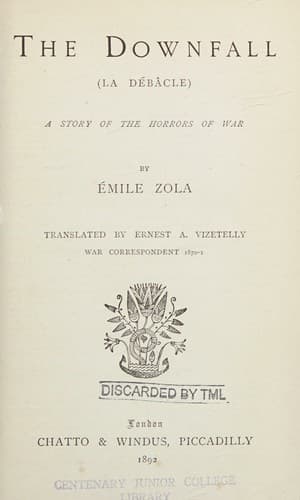
The Downfall (La Débâcle): A Story of the Horrors of WarZola, Émile
General
The Downfall (La Débâcle): A Story of the Horrors of War
Zola, Émile
Franco-Prussian War, 1870-1871 -- Fiction
'My novels have always been written with a higher aim than merely
to amuse. I have so high an opinion of the novel as a means of
expression--I consider it parallel with lyrical poetry, as the highest
form of literary expression, just as in the last century the drama was
the highest form of expression--that it is on this account that I have
chosen it as the form in which to present to the world what I wish to
say on the social, scientific, and psychological problems that occupy
the minds of thinking men. But for this I might have said what I wanted
to say to the world in another form. But the novel has to-day risen
from the place which it held in the last century at the table of the
banquet of letters. It was then the idle pastime of the hour, and sat
low down between the fable and the idyll. To-day it contains, or may be
made to contain, everything; and it is because that is my creed that I
am a novelist. I have, to my thinking, certain contributions to make
to the thought of the world on certain subjects, and I have chosen
the novel as the best way of communicating these contributions to the
world. Thus "La Débâcle," in the form of a very precise and accurate
relation of a series of historical facts--in other words, in the form
of a realistic historical novel--is a document on the psychology of
France in 1870. This will explain the enormous number of characters
which figure in the book. Each character represents one _état d'âme
psychologique_ of the France of the day. If my work be well done, the
reader will be able to understand what was in men's minds and what was
the bent of men's minds--what they thought, and how they thought, at
that period.'
* * * * *
As might have been expected with a work dealing with such a question as
the last Franco-German War, 'La Débâcle' has given rise to considerable
controversy in France. Some ultra-bellicose Frenchmen, and among them
M. de Vogue of the Academy, have taunted the author with a lack of
patriotism, their notion being apparently that they ought never to be
told the truth concerning themselves. Other persons have impeached
M. Zola's accuracy with regard to various matters of detail, and a
few have gone so far as to accuse him of having written that which he
must have known to be untrue. It may be as well to notice some of the
charges here.
Public-domain text, read in full here on John Shaqi.
Reviews
Reviews
No reviews yet
Be the first to share your thoughts on this work.
Join the Discussion
Join the discussion
Sign in to leave a comment or review.
Sign InorCreate an account