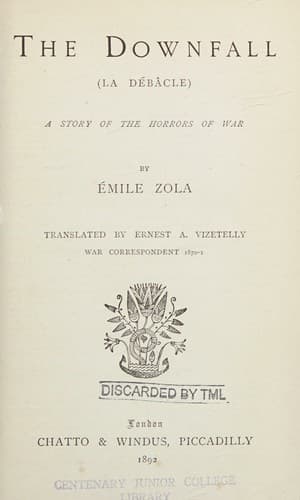
The Downfall (La Débâcle): A Story of the Horrors of WarZola, Émile
General
The Downfall (La Débâcle): A Story of the Horrors of War
Zola, Émile
Franco-Prussian War, 1870-1871 -- Fiction
It is said that there are no hop-gardens on the road from Mulhausen
to Altkirch, as will be found stated in Chapter II. (Part I.), and
in this instance it would really appear that M. Zola has fallen into
error. Viewing the road from a distance, and being very short-sighted,
he doubtless mistook vineyards for hop-grounds. The error is in some
degree excusable, however, when it is remembered that in this part of
Alsace the vines are trained to poles ten and eleven feet high. It
is also denied that vast sums of money were distributed among the men
of the Seventh Army Corps without any written acknowledgment at the
close of the battle of Sedan, as will be found stated in Chapter VII.
(Part II.). I have reason to believe that it was the money of another
army corps which was thus distributed, and that M. Zola transposed the
incident for the purposes of his story. A little license of this kind
is surely allowable in a work of fiction. M. Paul de Cassagnac, the
well-known Bonapartist politician and journalist, denies that Napoleon
III. had his face rouged and powdered on the morning of the battle
of Sedan (Sept. 1), in proof of which he mentions that he was with
Napoleon during the whole of the battle of Mouzon (Aug. 30), and also
frequently ate at the Imperial table during the campaign. M. Zola does
not state that Napoleon habitually painted his face. He says (Chapters
I. and III., Part II.) that he did so on one occasion only, early on
the morning of Sept. 1, and that the rouge, &c, was entirely washed
away by perspiration at 11 a.m., when he returned into the town from
the front. The battle of Mouzon and what occurred at other times during
the campaign have nothing to do with the matter, and M. de Cassagnac's
so-called denial is beside the question. The same may be said of the
denials of M. Robert Mitchell, another Bonapartist politician and
journalist, and of the Princess Mathilde Bonaparte, daughter of King
Jerôme. The princess was not even at Sedan, and can know nothing of
the matter. Moreover, is it likely that she would admit the accuracy
of any statement at all disparaging to the memory of Napoleon III.?
Is it likely that M. de Cassagnac would do so? Or M. Robert Mitchell
either? These gentlemen upheld the Imperial _régime_ through thick and
thin, and the former, at any rate, was most liberally rewarded for his
services. He has, therefore, good reason to be prejudiced. M. Zola
declares that he had the information in dispute in part from 'a certain
lady,' and in part from various people of Sedan, and so far there is
nothing to prove that it is inaccurate.
Public-domain text, read in full here on John Shaqi.
Reviews
Reviews
No reviews yet
Be the first to share your thoughts on this work.
Join the Discussion
Join the discussion
Sign in to leave a comment or review.
Sign InorCreate an account