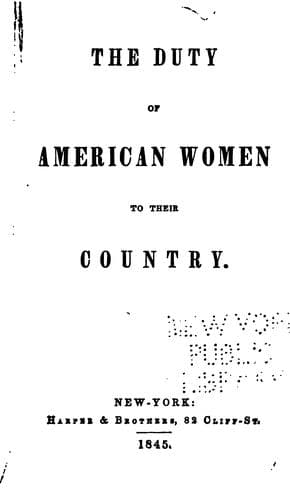
The Duty of American Women to Their CountryBeecher, Catharine Esther
History
The Duty of American Women to Their Country
Beecher, Catharine Esther
Education; Education -- United States; Women teachers -- United States
Is it asked, What then; would you require every woman to turn teacher and
keep school? No; but every woman is bound to bring this into the list of
_her duties_, and, as one of her most imperious duties, _to do all in her
power to secure a proper education to the American children now coming
upon the stage_.
Every woman has various duties pressing upon her attention. It is right
for her, it is her duty, to cultivate her own mind by reading and study,
not merely for her own gratification or credit, but with the great end
in view of employing her knowledge and energies for the good of others.
It is right, and a duty for a woman to attend to domestic affairs; but,
except in cases of emergency, it is not right to devote all her time
to this alone. It is a duty for her to attend to religious efforts and
ordinances; but it is not right for her to give all her time to these
alone. It is right for her to devote some time to social enjoyments,
some time to the elegancies and ornaments of taste, some time to the
adornment of person and residence, and some time to the relaxation of
mere amusement. In many cases, these last are as much duties as the more
weighty pursuits of life.
But this great maxim is ever to be borne in mind, _The most important
things first in attention_. It is _the due proportion_ of time and
attention that decides the rectitude of all useful or innocent pursuits.
And a woman is bound so to divide her time, as to give _some_ portion
of it to each of her several duties, so that no one shall be entirely
crowded out; and so, also, to apportion her attention, that each shall be
regarded according to _its relative value_.
In this view of the subject, what, except her own immortal interest, can
an American woman place, as demanding more serious attention and more
earnest efforts, than an attempt to use her time and influence to avert
the dangers now impending over her country, her kindred, and herself? Is
there any ornamental design, any gratification of taste or appetite,
any merely temporal good, that can at all be placed in comparison with
this great concern? Is it, then, assuming too much to claim that every
American woman is bound to give, not only _some_ time, but _more_ time
to this enterprise than she gives to any social enjoyment, any personal
or domestic decoration, or any species of amusement? Is it not so? Is
it right for a conscientious woman, when all that is dear and sacred is
in such peril--when she has means, time, or influence which will aid in
saving her country, her friends, and herself from such dangers--is it
right to give to this effort less attention and time than is devoted to
visiting, or to entertaining company, or to the adornment of her person
or her house? Judge ye, as ye will give account for these things to the
Judge of quick and dead.
What, then, are the ways in which an educated woman can employ the
talents committed to her for the salvation of her country?
Public-domain text, read in full here on John Shaqi.
Reviews
Reviews
No reviews yet
Be the first to share your thoughts on this work.
Join the Discussion
Join the discussion
Sign in to leave a comment or review.
Sign InorCreate an account