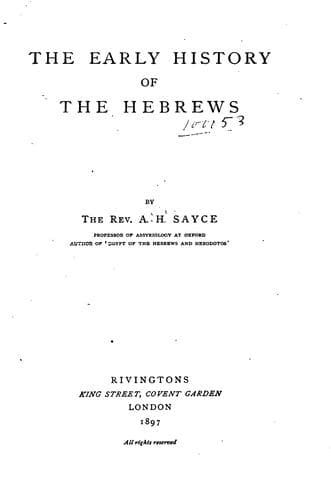
The early history of the HebrewsSayce, A. H. (Archibald Henry)
History
The early history of the Hebrews
Sayce, A. H. (Archibald Henry)
Bible. Old Testament -- Criticism, interpretation, etc.; Jews -- History -- To 953 B.C.
Where it is possible, the Biblical narratives must be compared with the
discoveries of archæological research; where this cannot be done, they
must be examined from the historical and not from the philological or
literary point of view. We are bound to assume their general credibility
and faithfulness, except where this can be historically disproved, and
to remember that while on the one hand inconsistencies in detail do not
affect the general historical trustworthiness of a document, the
agreement of such details with the facts of archæology or geography—more
especially when they are of the kind termed ‘undesigned coincidences’—is
a powerful argument in its favour. Above all, we must beware of that
favourite weapon of literary criticism, the argument from silence, which
is really merely an argument from the imperfection of our own knowledge,
and which a single instance to the contrary will overthrow. The literary
criticism of the Old Testament is full of examples of the argument that
have been demolished by the advance of Oriental archæology.
Let this accordingly be the rule of the historian: to believe all
things, to hope all things, but at the same time to test and try all
things. And the test must be scientific, not what we assume to be
probable or natural, but external testimony in the shape of
archæological or geographical facts. The history of the past is not what
ought to have happened according to the ideas of the critic, but what
actually did happen.
Such a manner of treating our authorities does not, of course, exclude
our recognition of what the literary critics call their several
‘tendencies.’ No history, worthy of the name, can be written without a
‘tendency’ of some sort on the part of the writer, even though it be not
consciously felt. We must have some kind of general theory within the
lines of which our facts may be grouped; and however much we may strive
to be impartial, our conception of the facts themselves, and our mode of
presenting them, will be coloured by our beliefs and education. The
historian cannot help writing with an object in view; the necessities of
the subject require it.
Public-domain text, read in full here on John Shaqi.
Reviews
Reviews
No reviews yet
Be the first to share your thoughts on this work.
Elsewhere in the archive
Join the Discussion
Join the discussion
Sign in to leave a comment or review.
Sign InorCreate an account