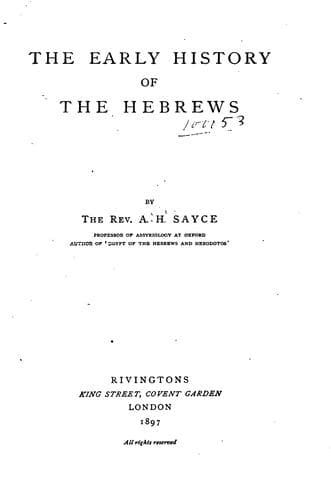
The early history of the HebrewsSayce, A. H. (Archibald Henry)
History
The early history of the Hebrews
Sayce, A. H. (Archibald Henry)
Bible. Old Testament -- Criticism, interpretation, etc.; Jews -- History -- To 953 B.C.
That the historical books of the Old Testament should have been written
with a ‘tendency’ is therefore natural. And literary criticism has
successfully pointed out in the case of one of these books what the
‘tendency’ was. If we compare the books of Chronicles with those of
Samuel and Kings, the contrast between them strikes the eye at once. The
interest of the Chronicler is centred in the history of the Jewish
temple and ritual, of its priests and Levites, and the manifold
requirements of the Law. His history of Israel accordingly becomes a
history of Israelitish ritual; all else is put aside or treated in the
briefest fashion. The incidents of David’s reign narrated in the books
of Samuel are subordinated to elaborate accounts of his arrangements for
the services in the tabernacle or temple; the history of the northern
kingdom of Israel, which lay outside that of the temple at Jerusalem, is
passed over in silence; and the Passover held in Hezekiah’s reign, about
which not a word is said in the books of Kings, is dwelt upon to the
exclusion of almost everything else. Nor, had we only the Chronicler in
our hands, should we know that the pious Hezekiah had entered into an
alliance with the Babylonian king and boastfully displayed to his
ambassadors the treasures of the Jewish kingdom, thereby bringing upon
himself the rebuke of the prophet Isaiah. All that the Chronicler has to
say on the matter is that ‘in the business of the ambassadors of the
prince of Babylon, who sent to inquire of the wonder that was done in
the land, God left him, to try him, that he might know all that was in
his heart’; and even here a theological turn is given to the occurrence
by the motive assigned for the embassy. As a matter of fact, we know
from the cuneiform inscriptions that the real object of Merodach-baladan
was to form a league with the princes of the West against their common
Assyrian enemy, to which, as the books of Kings inform us, was naturally
added a polite inquiry after Hezekiah’s health.
Public-domain text, read in full here on John Shaqi.
Reviews
Reviews
No reviews yet
Be the first to share your thoughts on this work.
Elsewhere in the archive
Join the Discussion
Join the discussion
Sign in to leave a comment or review.
Sign InorCreate an account