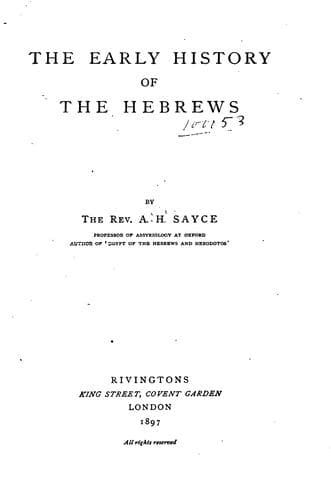
The early history of the HebrewsSayce, A. H. (Archibald Henry)
History
The early history of the Hebrews
Sayce, A. H. (Archibald Henry)
Bible. Old Testament -- Criticism, interpretation, etc.; Jews -- History -- To 953 B.C.
‘Tendencies’ there are, therefore, in the historical writings of the Old
Testament; they would not be human productions if there were not. The
authors have had one great object in view, that of showing from the past
history of the people that sin brings punishment with it, while a
blessing follows upon righteous action. They believed in the Divine
government of the world, and wrote with that belief clearly before them.
They believed also that Israel was the chosen nation in whose history
that Divine government had been made manifest to mankind, and that the
God of Israel was the one true omnipotent God. In this belief in a
theodicy they were theologians, like most other Oriental writers. But
their theological point of view did not prevent them from being
historians as well. It did not interfere with their honestly recording
the course of events as it had been handed down to them, or reproducing
their authorities without intentional change. Doubtless they may have
made mistakes at times, their judgment may not always have been strictly
critical or correct, and want of sufficient materials may now and then
have led them into error. But when we find that no attempt is made to
palliate or conceal the sins and shortcomings of their most cherished
national heroes, that even the reverses of the nation are chronicled
equally with its successes, and that the early period of its history is
confessed to have been one of anarchy and crime, and not the golden age
of which popular (and even historical) imagination loves to dream, we
are justified in according to them, in spite of their theological
‘tendencies,’ a considerable measure of confidence.
It will have been noticed that chronology—the skeleton, as it were, on
which the flesh of history is laid—has been alluded to in the previous
chapter only in the vaguest possible manner. ‘The age of Abraham,’ ‘the
age of the Exodus,’ ‘the Mosaic age,’ are the phrases that have been
used in referring to Old Testament events. Israelitish chronology in the
true sense of the word does not begin till the reign of David, and even
then we have to deal with probabilities rather than with facts. Like
Egyptian history, which has to be measured by dynasties instead of dates
before the rise of the eighteenth dynasty, the early history of the
Hebrews has no chronological record. Before we can attach dates to the
events of the patriarchal period or the Exodus, it is necessary to find
synchronisms between them and the dated history of other peoples.
Public-domain text, read in full here on John Shaqi.
Reviews
Reviews
No reviews yet
Be the first to share your thoughts on this work.
Elsewhere in the archive
Join the Discussion
Join the discussion
Sign in to leave a comment or review.
Sign InorCreate an account