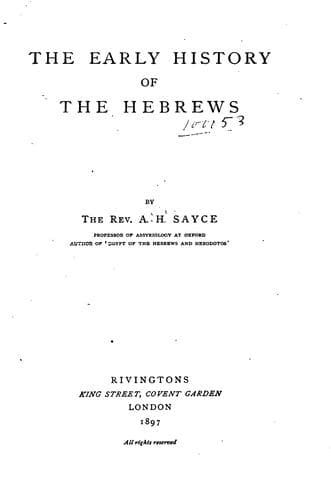
The early history of the HebrewsSayce, A. H. (Archibald Henry)
History
The early history of the Hebrews
Sayce, A. H. (Archibald Henry)
Bible. Old Testament -- Criticism, interpretation, etc.; Jews -- History -- To 953 B.C.
Footnote 273:
Thus, in a despatch sent to one of the later Assyrian kings, the
writer says, ‘I am a dog, a dog of the king his lord’ (Harper,
_Assyrian and Babylonian Letters_, iv. p. 460).
Footnote 274:
Josh. xv. 49. In one of the Tel el-Amarna tablets Ebed-Tob of
Jerusalem, when referring to the Khabiri or ‘Hebronites,’ speaks of
Bit-Sâni, which may be the Kirjath-Sannah of the Old Testament.
Winckler (_Tell el-Amarna Letters_, 185) has given a wrong translation
of the passage, which is partly based on an incorrect copy of the
text. The translation should be, ‘Behold Gath-Carmel has fallen to
Tagi and the men of Gath. He is in Bit-Sâni, and we will bring it
about that they give Labai and the land of the Sutê (Bedâwin) to the
district of the Khabiri.’
Footnote 275:
The determinative of ‘writing’ is attached to the word Sopher, showing
that the Egyptian scribe was acquainted with its meaning. The name of
Beth-Sopher (_Baitha-Thupar_) was first deciphered on the papyrus by
Dr. W. Max Müller, and published in his _Asien und Europa_.
Footnote 276:
Not the pluperfect, as in the Authorised Version.
Footnote 277:
See above, p. 247.
Footnote 278:
The latter reading (Judg. ii. 9) is probably the more correct. The
name of Timnath-heres, ‘the portion of the Sun-god,’ may have been
changed to Timnath-serah, ‘the portion of abundance,’ on account of
its idolatrous associations. Perhaps it is the modern Kafr Hâris, nine
miles south of Shechem.
CHAPTER V
THE AGE OF THE JUDGES
The Condition of Israel—The Destruction of the Benjamites—Story of
Micah and the Conquest of Dan—Chushan-rishathaim- and Ramses
III.—Office of Judge—Eglon of Moab—The Philistines—Deborah and
Barak—Sisera and the Hittites—The Song of Deborah—Gideon—Kingdom of
Abimelech—Jephthah—Sacrifice of his Daughter—Defeat and Slaughter of
the Ephraimites—Samson—Historical Character of the Book of Judges.
Israel has at last forced its way into the Promised Land. Mount Ephraim
is in its hands, and it has already planted itself in other parts of
Palestine. Joshua, the leader who taught it how to cross the Jordan and
defeat the princes of Canaan, is dead. The age of wandering is over; the
age of settlement has begun.
But the age of settlement was a stormy one. The Canaanites were but
partially subdued; the Israelites themselves were little better than a
collection of raiding bands. They had brought with them, moreover, the
nomadic habits of the desert, and were but little inclined to rebuild
the cities which they had so ruthlessly destroyed. And in almost every
direction they were encircled by enemies, better organised, better
armed, or more numerous than themselves, who from time to time succeeded
in overrunning their fields and reducing them to subjection. The tribes
who had dreamed of conquering Canaan found themselves, instead, the prey
of others.
Public-domain text, read in full here on John Shaqi.
Reviews
Reviews
No reviews yet
Be the first to share your thoughts on this work.
Elsewhere in the archive
Join the Discussion
Join the discussion
Sign in to leave a comment or review.
Sign InorCreate an account