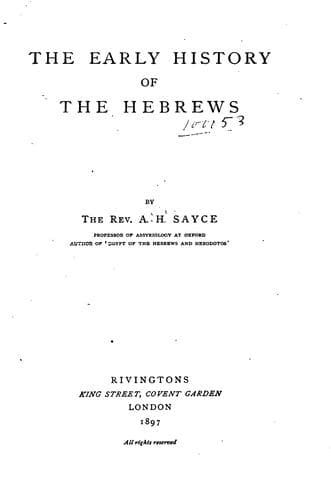
The early history of the HebrewsSayce, A. H. (Archibald Henry)
History
The early history of the Hebrews
Sayce, A. H. (Archibald Henry)
Bible. Old Testament -- Criticism, interpretation, etc.; Jews -- History -- To 953 B.C.
If the older inhabitants of the country were Amorite by race, the
kingdom of Sihon will have represented an Amorite reaction against the
descendants of Lot. But we must remember that the Babylonians had given
the name of ‘Amorite’ to all the populations of Palestine and the
adjoining districts, whether they were Amorites in blood or not. The old
Babylonian usage is followed in several passages of the Pentateuch, and
points to their origin in those pre-Mosaic days when Babylonian
influence was still dominant in Western Asia. Thus in Gen. xv. 16, God
declares to Abraham that ‘the iniquity of the Amorites is not yet full,’
and Jacob reminded his sons (Gen. xlviii. 22) that he had wrested
Shechem ‘out of the hand of the Amorite’ with his sword and bow. Perhaps
the emphatic statement that ‘the Canaanite was then in the land,’ which
we read in Gen. xii. 6, is due to the previous mention of the terebinth
of Moreh’ or Martu, Martu being the primitive Babylonian equivalent of
the later ‘Amorite.’ The terebinth, indeed, was in the country of the
Amorites, but the country was already inhabited by Canaanitish
tribes.[59]
We cannot, then, be certain that the aboriginal peoples of Moab and
Ammon were actually of the Amorite race. They were, it is true, included
by the Babylonians under the common name of ‘Amorites,’ but this was
because all the rest of the population of Southern Syria was known under
the same title. The fact, however, that the Hebrew writers have
described them as tall, like the Anakim, and that popular tradition
should have spoken of them as Rephaim or giants, is in favour of their
having been really of Amorite descent. In this case we may see in them
the easternmost representatives of the blond race, and the builders of
the cromlechs with which the hillsides of Moab are covered.
Public-domain text, read in full here on John Shaqi.
Reviews
Reviews
No reviews yet
Be the first to share your thoughts on this work.
Join the Discussion
Join the discussion
Sign in to leave a comment or review.
Sign InorCreate an account